Patricia Escobar, Nanny

by Lisa Calcasola

Patricia Escobar is a small woman with a golden heart. Ms. Escobar, like Mr. David Felicier and other adults gathering every Saturday to achieve their high school equivalency degree in lower Manhattan, notes the heavy emphasis on a diploma in today’s society. However unlike her husband, her reasons for getting her high school equivalency are a little different from simply moving up in the workaday world.

“It is such a blessing for me to be here,” says Ms. Escobar, smiling wide. “Especially for free! I am grateful every day for this opportunity and for these amazing teachers who never give up on us. That means so much.”

Ms. Escobar grew up in Mexico in poverty. She came to the United States at 21 years old to work as a nanny. Ever since she’s been a child herself, Ms. Escobar has been in love with helping children play and grow. Continue reading

Marc, 27, Guatemalan Busboy

by Megan Caldwell

Marc was waiting for a stoplight to change in the midtown Manhattan. He was wearing long black pants with black shiny shoes. Marc had just finished his shift at one of the best restaurants in the city. Although he asked me not to share the name of the restaurant he works for, he did talk about himself and his journey to the US.

Marc grew up in Guatemala with nine siblings and a single mother. His father left to work in one of the big cities when Marc was 13. Unfortunately, his father died in an accident, and Marc and his mother were left to raise the rest of the children. As the eldest brother, Marc tried his best to make sure his younger siblings could attend school.

Marc volunteered as a cafeteria worker when he graduated high school. The school would allow his siblings to freely attend classes in exchange for his services in the kitchen. Knowing this was not a permanent job, Marc eventually decided to move to New York and make money to send back to his family.

At the age of 27, Marc is working at one of the best restaurants in the city and he was extremely proud of that accomplishment. Working for a much smaller establishment initially, he applied to many jobs, eventually being hired to clean this five-star restaurant after operating hours. After a few months of that, he became a bus boy and now wants to be a host for the restaurant.

Marc told me that his “move to America was the best decision he ever made”. Marc has been saving money to help his siblings attend universities in Guatemala, help his mother with some of her medical bills and pay for one of his siblings to get braces. “Money is very different where I am from”, Marc explained, “a little money gets you a long way, but not here in the US”. In order to send money home to his family, Marc cannot afford to pay for housing and food. He sleeps on his friend’s couch and eats food only at the restaurant, as meals during shifts are free.


Espieman Dumé, Barbershop owner

IMG_2367

by Matthew Kelly

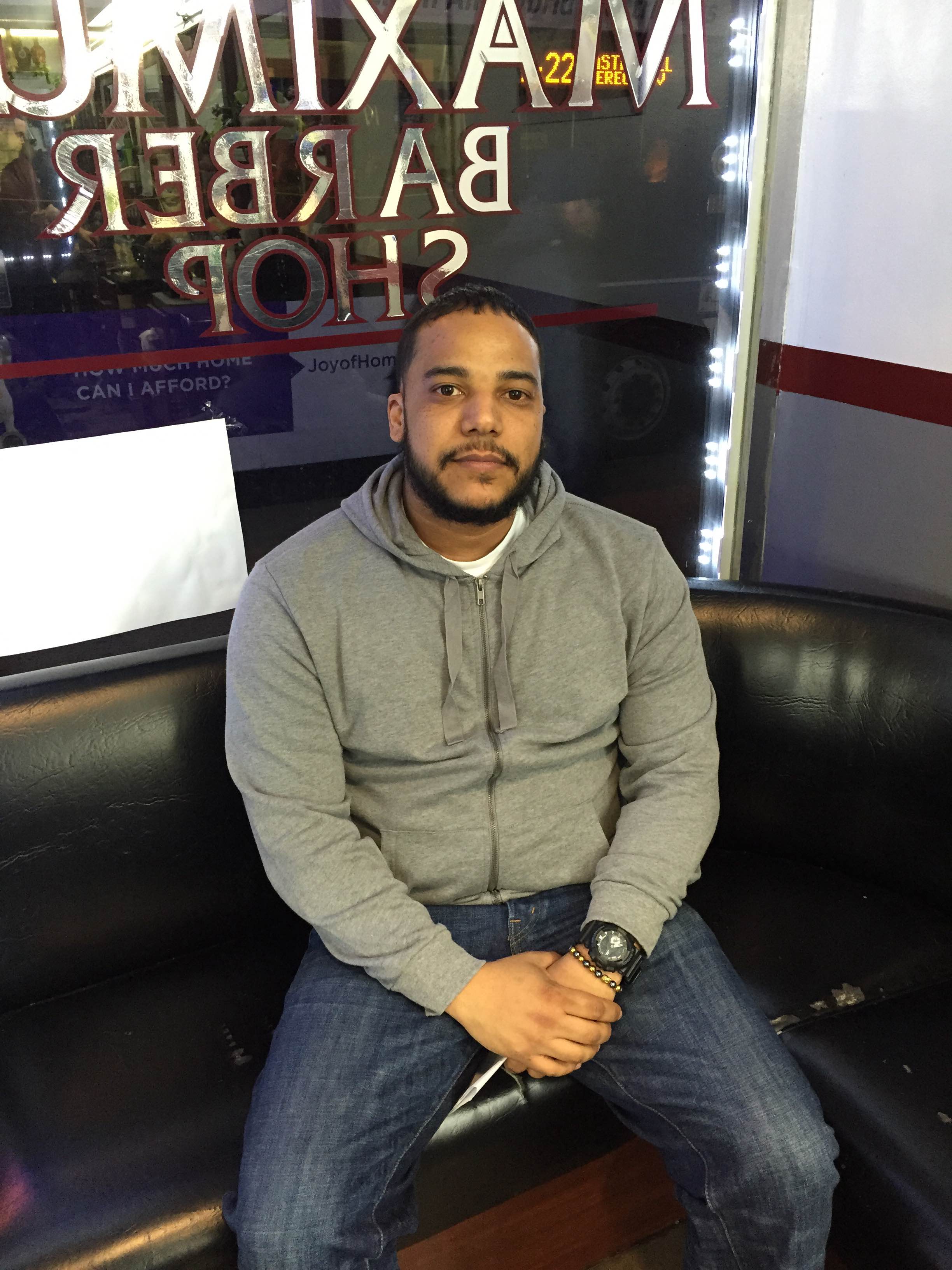
Moving to the United States with his mother as a child, Espieman Dumé, owner of Maximum Barber Shop in the Bronx, is a self-made man, a product of his own hard work and determination, and now he sponsors a program to help others.

Dumé and his mother came to the United States from the Dominican Republic in search of a better life, and the two settled into Manhattan when he was 7 years old. The two later moved to the Bronx, where Espieman attended high school. While he found the transition to life in the Bronx to be rather easy because he found a similar Hispanic culture, he told me of the struggles he faced while getting his education when it came to the language barrier and acquiring school supplies. He spoke of how as an immigrant, it was difficult to get the latest school supplies such as textbooks, some of which dated back as far back as the 1970s.

Despite these obstacles, Dumé was motivated to one day open his own business to attain the life he and his mother sought when they came to this country. After high school he worked minimum wage jobs as a means of income, at fast foot restaurants and other similar jobs. He also spent his summers back in the Dominican Republic with his father, who owned a restaurant of his own, and here Espieman learned how to operate his own business.

With the skills he had learned from his father and in pursuit of his dream of owning his own business, Dumé opened his first Maximum Barber Shop in November, 2005. Most recently, Espieman opened a second barbershop on Fordham Road in November, 2009, which in itself has become apart of the community. Maximum Barber Shop sponsors a ‘Be Better’ program in partnership with Fordham University, taking students from four local high schools and providing them with free hair cuts, Fordham sportswear, and guidance as they graduate school. Espieman hopes to expand this program in the future, and help more kids in the community.

Through his own determination, Espieman has established himself as a successful businessman after coming from humble beginnings. His shop serves hundreds of Fordham students and people in the Bronx, as he continues to expand his business and better the community.
 

Amar, Bangladeshi pizza maker

By Megan Caldwell

It was about midnight on a Thursday when I stopped by the 99% Pizza window in Murray Hill and met Amar, a young Bangladeshi worker who makes pizzas for a living.

Amar, 27, is a Bangladeshi immigrant living in Queens. He has only been in

the states for 16 months. Amar originally moved to America after he watched his  cousins immigrate and get jobs as taxi drivers. They were able to send money back  to their families that helped keep the family rice farms alive. Deciding to leave his wife and baby, Amar moved to the U.S. where his cousins had secured him a job at the pizzeria.

Although making Pizzas is not something Amar hopes to continue, he believes “Life is good and pizza makes it better  . . .  if I have learned one thing at this job, it is how to make the best pizza in under 10 minutes.” He joked that everyone in his village will love him since pizza is a luxury in Bangladesh; he will be a celebrity as a pizza maker! To work at a pizzeria in his country is a good job with good pay, enough money to send his kid to school, but in the U.S. it is not even enough to pay his rent.

While immersing himself in a foreign culture has been incredibly difficult, Amar has found a Hindi community in Queens that reminds him of home. He has discovered some fun that comes with being an “American”, such as joining indoor sports leagues and driving his cousin’s car (in his village they use mostly bicycles).  Amar’s dodge ball league meets once a week, he showed me their bright blue t-shirt design, which had “Bangladodgy” written in green letters across the front with the Bangladeshi flag pasted on the bottom. He laughed, and said the one thing he has enjoyed about being in America is that there is time for fun and that people take that for granted. Back in his village, life revolves around farm work, sleep and providing for children. “It is a great life but a simple life that doesn’t involve technology”.

Amar hopes to stay in the states for 3 years, than return home for a year and then come back to the states again, as it is the only way for him to make enough money to give his family the life they deserve. Bangladesh is a great country and Amar hopes his family will be able to stay there because he does not think America is a good place for immigrants. He says, “Immigrants are worked to the bone and get very little in return.”

Dominick, Public Safety team

By Victoria Van Demark

Dominick is a member of the Public Safety team at Fordham University.

His duties consist of monitoring cameras, taking phone calls, dispatching vehicles, as well as dispatching Emergency Medical Services. Dominick most looks forward to the emergency calls. There is always something interesting on the other end of the line.

He has a 45-minute commute from Connecticut to the Bronx. However, he does not work a seven day week. While each week is different, he typically works a 12 hour day adding up to a 48 hour week.

Dominick grew up in a family of five; his parents, his two sisters, and himself. His heritage is a mix of French, Haitian, and Dominican. When Dominick first came to New York he enjoyed spending time with his friends. After receiving his security license, Dominick went to
work at Fordham.

Dominick’s favorite thing about himself is his sense of humor. Throughout the interview he kept everyone laughing. His advice would be, “There is a time and a place for everything.”


Ana Medina, Residence Hall Director

By Matthew Kelly

The task of being the director of a residence hall is no small feat: Meet Finlay Hall’s director Ana Medina.

A Bronx native having lived most her childhood over on Sedgwick Avenue, Ms. Medina grew up in a neighborhood where there was gang violence. She attended Theodore Roosevelt High School not far from Rose Hill, which at the time was undergoing a ‘phasing out’ process, where the school divided students into different specialties. Within a week at Roosevelt she was selected for the Belmont Preparatory High School program, designed to prepare students for college.

Now at Belmont, Ms. Medina sought to escape the cliquey environment within the school, and quickly established herself within the school’s JROTC program. She spent her scheduled lunch period in the JROTC offices while earning an extra credit towards her diploma, eventually becoming the unit’s commander.

Perhaps the greatest hurtle she faced came during her senior year, when her family relocated from the Bronx to Harlem. Ana told me the greatest difficulty came in leaving a community she shared cultural similarities with in the Bronx, to being an outsider in her new community in Harlem. But rather than letting her environment get the best of her, she says she drew on the negative energy surrounding her and used it as motivation in the years after she graduated from college.

After graduating from Mount St. Vincent, Ms. Medina pursued non-profit work, having worked for organizations including TRIO, an outreach program for first-generation college students. She later worked for four years at the Sports and Arts in School Foundation, where she eventually became a program director for after school programs for children.

Ms. Medina found her way to Fordham, first as the resident director in O’Hare Hall and is now in Finlay Hall. Her passion for non-profits and commitment to help others has driven Ana to the success she has seen throughout her career to this point. In the future she plans to attain her masters in Nonprofit Leadership to further help first generation scholarship students.

Santiago Salazar, Auto Body Worker

by Megan Caldwell

Santiago Salazar was on the subway around 11:30 p.m. one recent night on a mostly empty, quiet car. He had clearly just left work, covered in what appeared to be soot, carrying with him a large stuffed backpack. Tentatively, he agreed to tell me about himself, though we used body language to get over a few Spanish-English bumps.

An immigrant from Puerto Rico, Santiago was friendly and seemed to enjoy talking to someone, as he said “nobody usually talks to me this late at night, I mostly listen to my iPod and think about what my wife cooked me for dinner.” He works at a local auto body shop for about 7 hours a day and then commutes home to his wife, who works for a cleaning services. Santiago wears a t-shirt and jeans because working on cars can get quite messy.

He came to the United States two years ago, and found the transition difficult because it has been hard to learn English; the language issue is the only thing he felt was keeping him from making more money When Santiago came to the United States, he interviewed for a job at a real estate agency, but they told him to come back when his English was better, which is exactly what he intends to do.

In Puerto Rico, Santiago was college educated and worked for a well-known construction company, managing work sites. “It’s confusing how my college education means nothing now that I am in the U.S., but in Puerto Rico I was considered very, very smart”, he told me. Santiago seemed disappointed that his credentials and degrees did not transfer over when he moved here. He hoped that he would be able to get a good job and make lots of money. Santiago joked that his wife was trying to collect one million pennies so that they would have $10,000.

Santiago couldn’t wait to get home to his wife, who he loves “sobre la luna” which means “over the moon”. She cooks dinner and puts it in the fridge for him since he works until very late. He was going to warm up his dinner and watch and episode of modern family, his favorite TV show that one of his co-workers gave to him for Christmas

Tony Torres, Fordham Road Statue of Liberty

by Victoria Van Demark and Lisa Calcasola

His name is Tony Torres. You might pass him on the streets and never know his name, his story, or where he comes from. All you see is the guy dressed in one of those velvet green Statue of Liberty suits waving flyers around and maybe, if he’s good-humored, dancing to music from his iPod.

Tony stands on East Fordham Road next to the fruit/shampoo/knit hat market, across from the gated community of Fordham University. He’s wearing sunglasses and a black sweatshirt underneath his Lady Liberty getup. “Are you cold?” We ask. “Nah, I’m good,” he says, though that’s hard to believe on this windy February day. We approach Tony with hesitation. What questions can we ask that won’t be too intrusive or awkward? Tony’s ready for the challenge.

“I’m Puerto Rican and Dominican. I’ve lived in the Bronx my whole life. What else do you want to know?”

Tony is a student, studying to be a veterinary technician. Or he was, until he injured his leg. Now he is out of school, but he has no doubt he will be back to finish. When asked what made him interested in pursuing this career, he remarked, “Animals don’t lie. People do.” Continue reading

Tiffany, Bookstore cashier

by Victoria Van DeMark

When at the Fordham University Bookstore, one might meet Tiffany, a young, friendly and helpful employee. Tiffany works as a cashier and is always ready to assist customers in need. She works 15 hours a week during which she works at the check-out counter, stocks shelves, and helps students.

Tiffany grew up in a small family of both African descent on her Father’s side and Portuguese descent on her Mother’s side. Although originally from Brooklyn, Tiffany grew up, with her family, in the northern Bronx. For high school, she attended Fredrick Douglas Academy in Harlem. When asked about the best advice she ever received, Tiffany responded by saying “life goes on.”

One of Tiffany’s unique talents is her ability to play the violin. She began playing in 2001 while in Middle School. With her school, she has played at the Gap on 34th Street, she has traveled to Florida to perform and has played at Carnegie Hall. However, after graduating from Middle School, she no longer plays as much as she used to.

Although Tiffany enjoys her job at the bookstore, her dream job would be to be a Marriage and Relationship Counselor. She greatly enjoys helping others. Tiffany explained why she wants to be a counselor by saying, “I like talking” and “I give the best advice.”

Carlos Mendoza, Postal Clerk

postal

By Megan Caldwell

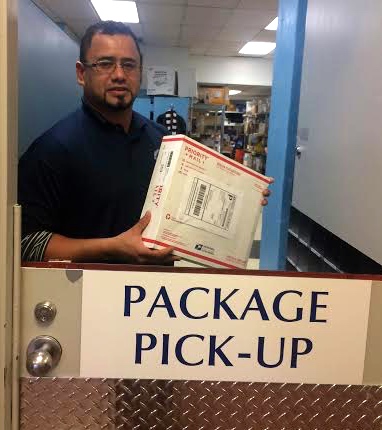
Sorting mail and handling packages is a large part of staffing the college post office.

One of the postal clerks at the package window is Carlos Mendoza, who spends 40 hours a week in the mailroom sorting mail, shelving packages, and correcting addresses that are mislabeled.

Originally from the Dominican Republic, Carlos moved to the United States 24 years ago in hopes of making a better living for himself.

He prides himself on his hardworking attitude and determination. Carlos believes these personality traits have allowed him to provide a great life for his family in the Bronx. Carlos has four children, with his eldest daughter graduating from Fordham in 2014 and attending Duke medical school. Carlos also hopes his other children will attend the university, as his daughter received an excellent education.

As a boy in the Dominican Republic, Carlos imagined himself as a professional basketball player. When asked about his favorite pastime, Carlos chuckled and said, “I’ve always loved basketball, I’m a Lakers fan all the way! I idolize Kobe Bryant.”

In a more serious tone, Carlos explained how he wished to be a lawyer at one point in his life, but realized this dream was also unrealistic.

With a clear emphasizes on the importance of higher education, Carlos feels the best advice he could give to his children would be to, “focus on education and be disciplined in all that you do, if you follow this simple rule, there is nothing you can’t achieve”