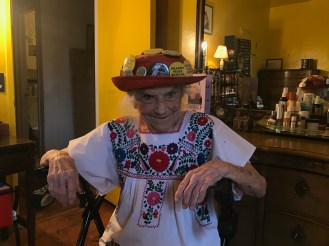
 Molly Klopot is a lifelong activist. For many years, she headed the Women’s International League for Peace and Freedom’s New York Chapter, initiating the active “gaggle” of the Raging Grannies. She had been involved in similar activities since the start of the Cold War, serving in East Berlin with the Women’s International Democratic Federation to develop international attention to women’s issues. A Detroit native, she was active in United Auto Worker strikes and demonstrations. She worked in the then-new Social Security Administration, where she worked to organize the first State, County and Municipal Workers of America union. She worked as a riveter and was among the first women to be a union rep. Later at Columbia University’s School of Social Work, she taught and counseled union members and worked with pregnant teens. She was a 2013 Clara Lemlich honoree.
Interview by Sereene Kurzum
Growing up, my father was a Communist and we were involved in a fraternal organization called the International Workers Order. This was a mutual benefit, Communist-affiliated organization. We were provided with medical care, the kids were taught to read and write in Yiddish, these were the kinds of services and cultural activities offered.
As Jews, we had our own organization with our own cultural activities, and the Poles had their organization, and it was divided up culturally like this. However, we all came together and existed as a community through the workers camp. We had choirs for the children and the adults, and we’d put on shows and plays for each other. We would all go to this same camp and come together as a community. This was the community I grew up in.
I was also a member of the Young Pioneers, a youth Communist organization. Because I was the chair, I would open all the meetings. We’d open them by singing the Internationale, a song for the workers of the world, and I’d shout, “Pioneers for the cause of the working class, are you ready?”, and they’d respond, “Always ready!” I’d say it with such fervor. We would have meetings and learn about how people lived and why it was a big time for organizing unions. I learned about the history of the working class, the beginning of the Congress of Industrial Organizations, and the fight for unionization.
I was heavily influenced by my father, and by belonging to the International Workers Order. I was meeting all these different kinds of people and working together with them. Another influence was belonging to the Young Pioneers. We were always reading and always studying, but at the same time, we were together as friends, and we’d sing and dance and have fun together. Even the parents belonged to choirs, and they’d have concerts. So we had this feeling of solidarity. This was our culture. It is why I have always had the feeling of being one with the world. Despite the bad experiences in life, despite being jailed several times. Because from the very beginning, I was always part of a bigger world. It’s how I grew up.
This was a time when the KKK were very active. One day at the worker’s camp, we were to have a meeting. We were all crowded into a big hall, filled with people, and the kids were outside talking. Then the KKK came. They had come to burn down the camp. They were downstairs, and they were going to get us when we left. So what did we do? We organized the kids to go marching around the hall singing our worker songs. By the time we finished the meeting and got downstairs, the cops had chased them away. These are the kinds of experiences I had.
I’ve spent much of my life organizing unions with a focus on women’s issues. The first union meeting I went to, they had never seen a woman at these union meetings. I was going to talk, and some man said something like, “Oh, this little lady wouldn’t!” So I got up to answer and I said what I wanted to say. Then they finally let me talk. Wherever I worked, I was always in a union. I always organized around women’s issues as well.
I worked as a social worker before and after the war. I began with Social Security, which provided aid to the blind, aid to dependent children, old age assistance, and so on. We organized a union there. I later went to LA and got a job in a hospital as a social worker, then moved to San Francisco, where I continued my social work. I organized unions in both those places.
When the war began and all the men went out to serve, they wanted the women to take over the factory jobs, so I got a job at Ford factory in Highland Park. There were all these women, the mothers and wives of the men who were overseas, working at the factory. The factory was supposed to be putting them to work making war missiles and things like that, which it was getting government money for. Instead, women were sitting around reading, and they weren’t given any work. So I organized all the women, I called the newspapers, and we had a picket line in front of the factory. Not to keep people from going in, but to let them know what was going on. So we were able to unionize there. That wasn’t the end of it though. Issues would arise and I’d continue to challenge the factory. For instance, I noticed that the factory was not hiring any black women, even those who were trained and qualified. So I organized a picket line for that as well. Again, not to keep people from going in, but to raise awareness. All the newspapers wrote about it. After that, the factory began hiring black women. I also organized a fashion show, showing the women how to cover their hair so it wouldn’t get caught in the machines, but still look good. That was in the newspapers as well.
Near the end of the war, the women had just gotten 40 cents an hour. The men of course still made more, but they made a big deal of honoring all the women who had worked in the factories and helped out during the war. They honored us, then the war ended, and they fired all of us.
These were the kinds of experiences of solidarity I had. When Paul Robeson sang at Peekskill, I was there. And, though I didn’t know it yet, so was my future husband. This was the concert that sparked the Peekskill riots, which were rooted in racism and antisemitism. Paul Robeson was up on a stand, and surrounding the field were all these people holding arms, forming a chain, throughout the concert. My husband was one of these people holding hands. Later when we left, we saw that the cops had been patrolling the entrance, letting one car out at a time, holding others back. There were men standing with stones, all throwing the stones at the cars. One man lost sight in his eye. A rock was thrown into his window and the glass shattered and a shard had hit his eye. I was lucky I didn’t get hurt. But these were the kinds of experiences I had, and in the end, I was lucky to have had them.
We went to the Board of Education of a school once. It had something to do with discrimination against black students, I don’t remember what the exact issue had been. But I do remember that the cops chased us out. So, I ran into a nearby street car and I sat down next to an African-American woman. The cop came to the door of the car and he was looking over everybody, and it was quite obvious he had been chasing me. The black woman who I was sitting next to, who I didn’t know, said “She’s with me.” So, the cop turned around and left. So I’ve had these experiences of solidarity in my life. Continue reading →
 Frances Goldin is an accomplished affordable housing activist and literary agent. She is the only surviving founding member of the Cooper Square Committee and has been active for over 50 years, fighting to save her neighborhood from destruction by construction running through the Lower East Side. In 2013, her committee’s alternative renewal plan was finally adopted and nearly 2,400 families previously at risk of displacement were able to secure their apartments for the next 200 years. She was a Clara Lemlich honoree in 2011.
 Connie Hogarth is a co-founder of WESPAC, the Westchester People’s Action Coalition, as well as the Connie Hogarth Center for Social Action at Manhattanville College in Purchase, NY. She was an active organizer with the 1984 and 1988 presidential campaigns of Rev. Jesse Jackson. Her activism contributed to the closing of Indian Point, the ending of apartheid in South Africa, and spurred local movements in environmental protection, human rights, gay rights, civil rights, affordable housing and equal educational opportunities. She has lived in New York all her life, traveled extensively, and she continues to be active in the Beacon Sloop Club, the Duchess County and Fishkill Democratic Committees, and the Southern Duchess County NAACP. She currently resides in Beacon, NY, overlooking the Hudson River. She was a Clara Lemlich honoree in 2012.
 Maddy Simon is an accomplished social activist, educator, and musician who has attended and led many rallies for causes such as labor issues and peace, among many social justice issues. Maddy was a professional choral conductor of many amateur choruses throughout the New York area. She also taught music in the New York high schools for over 25 years and was involved in Camp Kinderland for 70 years where she used musicals to teach campers the importance of social activism. Maddy is still involved in social activism through attending rallies and demonstrations and by teaching weekly Yiddish classes. She was a Clara Lemlich honoree in 2011.
 Lubow Wolynetz is the curator of folk art at the Ukrainian Museum on the Lower East Side in New York City. Born in Ukraine, she spent four years in a displaced persons camp in Germany following World War II, and then immigrated to the United States with her family. She studied at Hunter College and earned a Master in Library Science from Columbia University. She organized the Ukrainian Museum and Library of Stamford and continues to teach embroidery and other traditional crafts at the museum on the Lower East Side. She was a Clara Lemlich award winner in 2017.


 WorkersWrite