Jose Alejandro Guzmán, Retired Court Officer and Orchestra Conductor


unknown

“What we are doing in community music is recognizing the importance of culture. We get to be participants in works by geniuses in Western civilization.” The speaker is Jose Alejandro Guzman, conductor in several New York City community orchestras, talking about why he has been drawn to classical music and working with citizen musicians.

At age 70, the self-taught maestro is standing atop the podium in concert dress, ready to conduct orchestral scores from memory; he sees it a service, a calling even, to be able to offer thoughtful musical works to audiences who may not make it to top professional concerts.

“We get people who are very musically sophisticated and we get people who say they don’t know much, but they love the sound. That’s why we’re here.”

It’s a long way from growing up in the South Bronx and other poor neighborhoods in New York City, and a distinctly different way of seeing the world than from his 29 years as a court officer in New York family, criminal and civil supreme courtrooms.

“In Europe, every musical organization, every arts organization, is run or backed by the government, something that recognizes the importance of culture to people’s lives. In this country, the amount of government money for the entire NEA (National Endowment for the Arts) and support of all arts groups in the country is less than the cost of a single F-18, which should tell you all you need to know about this.”

Guzmán is musical director and conductor of the Centre Symphony and is conductor laureate of the New York Symphonic Arts Ensemble in Manhattan. He stepped down following 26 years as Music Director of the Regina Opera to devote more time to symphonic repertoire.  He is Music Director of the Staten Island Philharmonic and was formerly the Music Director of the Bronx Symphony Orchestra and the Rockaway-5 Towns Symphony Orchestra. In addition, he a frequent guest conductor, having appeared with the Bronx Arts Ensemble, the Bel Canto Opera, the Riverside Symphony, and the Massapequa Philharmonic Orchestra among other groups over the decades.

He likes performing with community groups, working with “anyone who really wants to be there,” noting that in immigrant-rich New York City, there are many musicians who moved from Europe where they found support to a more difficult life as musician here. “One of the best cellists I know is a housewife here in Brooklyn and works as a hair stylist” because she cannot support herself as a musician, he said. She is a graduate of the Saint Petersburg conservatory and performed with the Israeli Philharmonic, and she is not alone.

Community music for him represents democratic access to great culture, and something he found himself, taught himself, and learned to encourage.

Even just in New York City, there are numerous community non-pprofessional orchestras, dance, theater and and opera companies; he said, “I once conducted a community musical theater group where the children were now playing the roles their parents had played. There is talent out there and a thirst for Art that in unacknowledged. Yet I always hear ‘the Arts are dying.’ There is incredible ignorance among our leaders.”

His journey, he acknowledged, might be an exploration of finding balance, of finding strains of passion along with making a living and recognizing what makes for meaning in life.

His mother came from Puerto Rico to get away from his father, whom Guzmán describes as a drunkard and court clerk about whom he learned about only when his mother told him the story on his 51th birthday. “She never wanted to tell me,” he said.

His father refused to divorce his mother, who fled to New York City. His mother, Mary, who remained the most influential person in his life, was a seamstress who produced fine work, he said, but life in New York proved a difficult slog for her through welfare, night high school classes, learning English and various poor neighborhoods and housing projects, along with twin sons.

In the fourth or fifth grade in the Lower East Side, Guzmán, who dryly revels in self-deprecating humor, found music, and never let go. He played the trombone, then later, the trumpet, “but I was never any good at it. Still, those music teachers are the only ones I remember from that time. I was lucky that we still had music in school.”

He worked as a packer for Abraham & Strauss department stores (“I still can wrap anything so that it won’t break”), and wondered about a future. He described himself as a lackluster student who had trouble getting through high school. Almost by accident, he opened an envelope that invited him to attend New York Community College, a technical school that wanted liberal arts students, which took more than the allotted time, and finally at Hunter, where he started to formally explore a bit about music. Every part of it was difficult for him, he said, and he repeatedly found himself among peers who were better prepared. His take: Work harder to understand.

Throughout, he listened to classical music on the radio, though in school, “I was the fifth trumpet in a four-trumpet orchestra,” and was pleased to find a couple of courses in conducting where he found he had an aptitude. Being a good shortstop helped a lot.

His mother found a job working as a translator for the courts, and let him know about a vacancy for court officer, a union-covered civil service job, which he won despite being an undersized, skinny kid who was shy of the formal weight requirement, which a kind official overlooked. He spent several years at a family court in lower Manhattan, before moving to criminal trial courts for a year, and then civil courtrooms.

“It affected my political thinking, for sure,” he recalled, “I was a JFK liberal, and then I saw the effects of real life before me every day. The only difference between what I was seeing in family court and the criminal court was age of the defendants. Then, it was civil service, I was switched over to (trial) criminal courts. For a year.

“That’s where I saw hardened criminals, the bias against minorities, how people would treat each other, Were there dangerous moments, yes, but you’ve got to go where the noise is,” he said. “Thankfully, after a year, they needed bodies in the civil supreme court, so I moved there. The only criminals I saw there all had law degrees.” (Nevertheless, it was through court contact that he met his wife, Linda, a lawyer).

Actually, providing security for court officials and defendants meant sitting through thousands of actual court cases. “I can pick up a liar very quickly,” he said of his experience. Over time he became a captain at a . court facility on Thomas Street in Manhattan.

Over the years, it all made him “three steps to the right of Limbaugh” on issues involving crime and welfare, “which I knew, which I lived,” and much more liberal on issues involving religion, refugees, choice, free speech, arts support. He picks and chooses, though could not bring himself to vote in the 2008 election, the first time in his life.

Throughout, he listened to music, and started working as an assistant conductor in the Bronx. “I was an autodidact, teaching myself. When I was 59, I finally took a conducting class” and altered some of the things he had been doing in leading choral, opera and symphonic groups.

“Civilization, when you come down to it is about its arts.” Every civilization is what it’s Arts say it is.

Over the years, some groups, like Regina, have become stepping stones for talented, for younger singers to move up, and the orchestras have allowed many non-professionals to work together to pursue those lofty presentations. “It’s a team thing, we have to do it together,” the maestro explained. Indeed, with the groups, Guzmán is seen as a singularly humane and pleasant colleague who knows what he wants but often uses humor and grace to draw it from his players. The personalities of orchestra conductors often can set expectations for the music, but also can call for extra effort for individual musicians to find ways to blend, to work together, to achieve the final result.

Concert preparation for him takes months, he said, starting with listening to many versions of the piece, then working with the score, even fooling on the piano with certain passages to see relationships in the music.

“My musicians expect me to be prepared. To face an orchestra and not be totally prepared is an insult to them and your Art. By the time we have a first rehearsal, I know what I want to achieve in this performance.”

Even if only one person in the audience appreciates it or finds it fresh, “We have to be like Joe DiMaggio. People asked him why he would always try so hard. He said it was because if only one person was there, he didn’t want to make a bad impression.

We should not play for those who are in the know; but for the one guy out there who has never been to a concert before, who applauds in the wrong place and has never heard the music before but he likes it.”

 –Terry H. Schwadron

##


Anne Foner, Professor, Volunteer

ann-foner-pic

By Lizbeth Brosnan

Anne Foner, retired sociology professor, reminisces easily about her students and their ever-stimulating conversations. However, her least favorite part about 25 years of teaching at Rutgers University in New Jersey was the large volume of papers she had to grade.

After her husband, Mo,  became ill, she moved from Queens to Manhattan and cut back on her own writing and publishing, and turned to volunteer work.

Anne has two daughters and one granddaughter. One daughter lives on the Manhattan’s East side, while the other lives in her same Westside apartment building. She sees her family often and plans on getting together with them for the holidays.

After mandated retirement, Anne did not leave the field of sociology right away. She continued to be involved in academic publishing for as long as she could. “I was really lucky to continue to work,” Anne explained.

She also continued to volunteer at a number of places, Anne describes as a “continuity of what I was doing before.”  To Anne, retirement presented opportunity, adding that it is a  myth is that retirement is a terrible thing in which you lose all contacts and any meaningful work. She explains how not everything falls apart, and that it is just a different stage of life.

One organization where Anne had volunteered after retirement was called Partners in Conversation in Queens. Here, Anne helped those who did not know much English practice their English skills through conversation. She worked with a diverse group of men and women, ranging in age. Anne shared that when looking for somewhere to volunteer, “trying to find something interesting is not easy.”

As she got older, Anne also continued to teach classes at NYU. Anne had a long and extremely interesting career and is very lucky to be able to have continued to work in the field that she loved for so many years.

##


Freddy, Manager, Burger Lodge

By Lizbeth Brosnan

Burger Lodge, located on East 189th Street in the Bronx between Belmont and Cambreleng Avenue is a staple restaurant for Fordham students, catering to their desire for some traditional comfort food. The menu is large and diverse and the atmosphere is especially welcoming.  Hungry Fordham students can always be found in this popular joint.

The warm and welcoming atmosphere is something that makes Burger Lodge especially enjoyable for customers.

In talking to Freddy, manager of Burger Lodge, we learned some about his family and the history of the restaurant, which opened last February. Freddy spoke with pride and respect about his son, Ferso, who is not only a student at Fordham University’s Gabelli School of Business, but the actual owner of Burger Lodge.  It is easy to tell that he is very proud of his son for accomplishing his dream of establishing a popular restaurant for college students.

Freddy, originally from Macedonia, has lived in the Bronx ever since coming to the United States.

The best part about Burger Lodge, he says, is that “The customers are happy with the food”. Everyone is always happy with the food. Freddy explained how the customers are mostly students from Fordham. There is even a Burger Lodge challenge, nicknamed “Lodgezilla” by a Fordham University student.

##

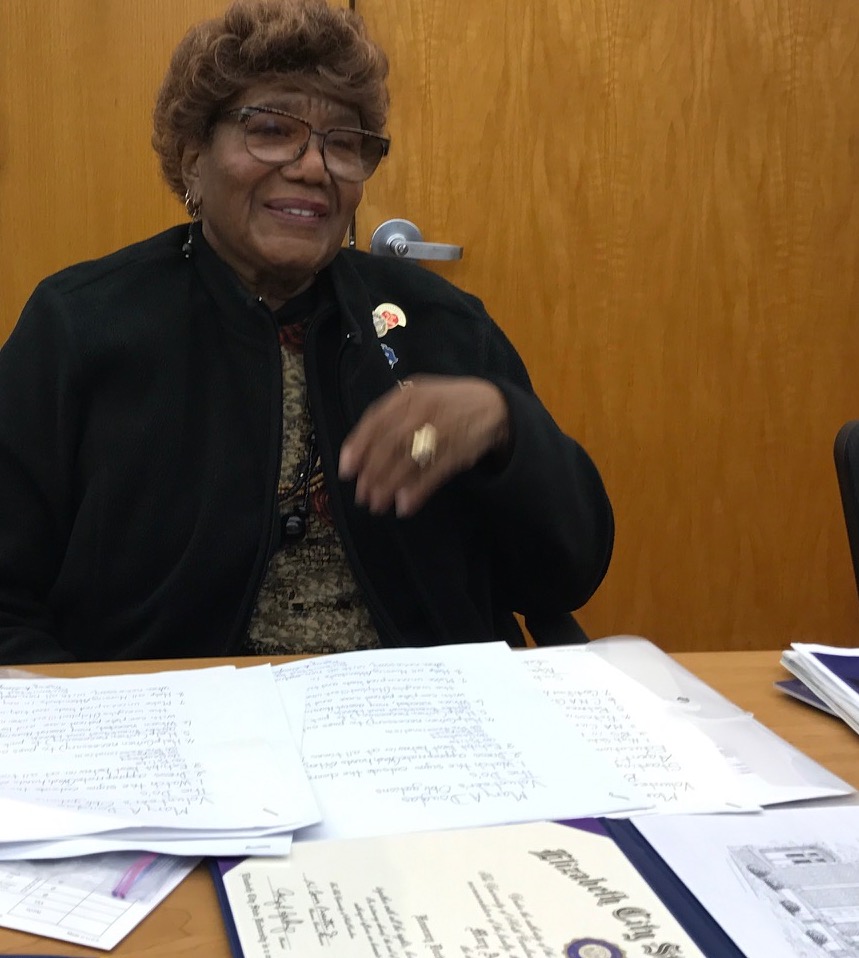
Mary Douglas, Hospital Volunteer

mary-douglas

Mary Douglas, Retired Schoolteacher

and Volunteer at St. Barnabas Hospital

by Katie Russo

Mary Douglas was introduced as a volunteer at St. Barnabas Hospital, but we quickly learned that she was so much more than that.

Douglas was born in the Outer Banks/Kitty Hawk region of North Carolina as Mary Albritton. Her parents were farmers. The first time she came to New York City was in high school, with some family.

Douglas was the valedictorian of her high school, and was loved and praised by all her teachers. She always knew she wanted to teach, and each teacher wanted to her to specialized in their subject. The principal of her high school told her the best thing for her to be was an elementary school teacher, in order to teach a bit of everything.

To become a teacher, Douglas attended Elizabeth City State University, where she said that the college president was like another parent to her. Both her parents and the president were hard on her and made sure she lived up to their standards, reminding her she didn’t know everything. That same president signed her on to live and work at the college her senior year, then recommended her to her first job in Crisfield, Maryland.

Douglas said she “felt so alone” in Crisfield, without anyone to look after her like her parents and the college president had. The teaching job she had there was very strict—they could not be seen buying alcohol or with people of ill repute, and had to attend church on Sundays. She met and married her husband, Frederick Richard Allen Douglas (who went by “Douglas” to avoid the inevitable conclusion of Frederick Douglass), a Korean War veteran. Eventually, they moved to New York City, where Mary Douglas taught at an elementary school on 180th Street, Louise Archer Elementary. She retired Feb. 2, 1985, at the age of 56.

Douglas had never taken a day off, so when she went to retire, she had months of paid leave she could use. She took her leave from September 1984 until January 1985, and used that time to attend medical aide training school. To become a certified nurse’s assistant (CNA), one must complete 122 hours of in class training and 32 hours of hospital training, the latter of which Douglas did at St. Barnabas Hospital. Douglas got 100 on her tests and was the top of her class at medical aide school, as well as being an honors student. She graduated in Riverside Church with her class of 1,500 people. The woman who ran the program, a Ms. Respoli, asked “What kind of people would you like to work with?” Douglas replied “Senior citizens” and has been working mostly with them ever since. Continue reading

Chris Borgatti, Ravioli Maker

aave_g-315x420

By Lizeth Brosnan and Jenna LoFaro

Chris Borgatti is the current owner of Borgatti’s Ravioli and Egg Noodles on 187th street just off of Arthur Avenue in the Bronx. Chris is the third generation to take ownership of this family run business.

He has worked in the store since he was a young boy with his father, Mario along with other family members. He says that working in the Borgatti store, at least for a short time, has become a rite of passage in his family. His own son worked in the store as a boy and now attends Fordham University’s continuing studies program after having graduated from the Gabelli School of Business.

Chris recounted some of the history of his beloved shop. He said that his grandparents opened the shop after immigrating to the Bronx from Italy, 81 years ago. At that time, the store was about half the size of what it is today.

He also spoke about the progression of their ravioli sales. Saying that originally, his grandparents would mass produce hundreds of tiny raviolis and sell them at a price of one dollar for every hundred.

Today, Chris still uses the same recipes as his grandparents did when the opened the shop in 1935. He notes that the demand and customer base for his family’s product is still very much alive and growing, something of which he is very proud.

Like many New Yorkers, he feels great connection to the neighborhood and city he grew up in. He is both happy and proud to be carrying on his family’s legacy in that very neighborhood today and to be continue providing the community with a high quality product.

Michael Zweig, Economist, Activist

unknown

By Jenna Lofaro

Michael Zweig is an accomplished economist, professor, and author. He has worked as a professor at SUNY at Stony Brook and been awarded the Chancellor’s Award for Excellence in teaching as well as the President’s Award for excellence in teaching.  He also sees himself as an activist in social causes.

When asked how he charted his life, he said that as a young adult he was very much like every other confused college student, unsure of direction.  His family always had maintained a large involvement in his life, and he remembers taking a lot of science and math courses because his father had been an engineer and his brother a mathematician. The concepts of math found in certain parts of economics were always there in the background.

While attending college, Michael also found himself involved in the Civil Rights Movement, which had just started to take off. Later, he found himself involved in many more social movements throughout the decades, including the anti-war movements over Vietnam.

He was and still is very passionate about social movements. Social movements are one of the main influences on history in today’s world, he said.

He even asked me why I thought social movements were so important in the nation’s history and how they had come about. He smiled and nodded in agreement to my answer that social movements build when groups of people feel they have not been heard and that their issues in society have not been acknowledged. So they band together and make themselves heard so that the problem no longer can be ignored.

Along with his involvement in social movements, Zweig is also very active union worker. Unions are very important to seeking and achieving goals for the group they present. Continue reading

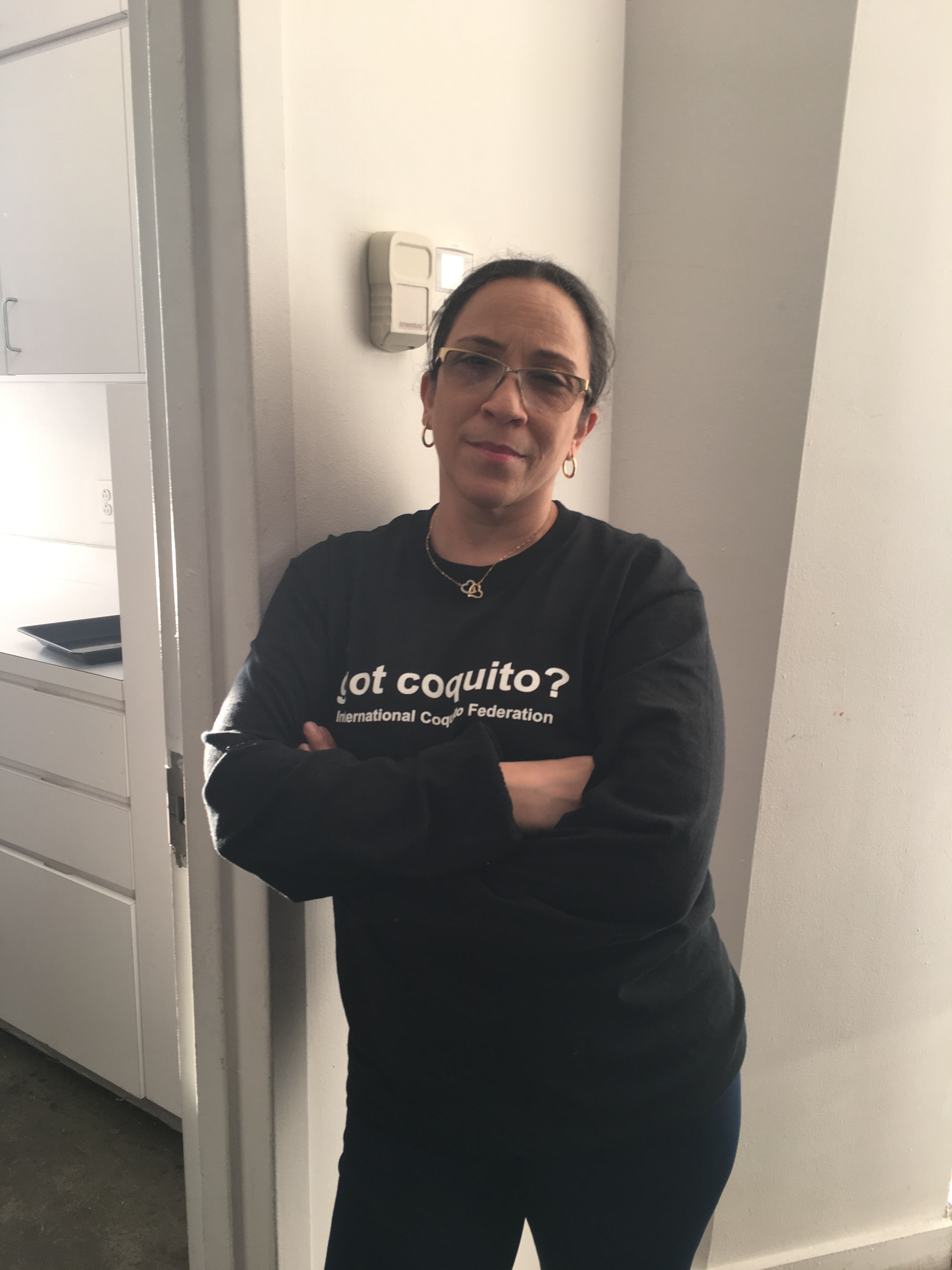
Debbie Quinones, Coquito mixer

debbiequinones

By Lisbeth Brosnan

Coquito is a coconut-based alcoholic beverage traditionally served in Puerto Rico. A Coquito recipe is unique to the family that makes it. On November 13, 2016, The Bronx Museum for the Arts hosted winners and finalists of the Annual Coquito Masters competition. This event allowed the finalists to sell their delicious coquitos at the museum.

Debbie Quinones, founder of the International Coquito Tasting Federation, spoke passionately and excitedly about the special Puerto Rican drink.

“The ingredients really represent imperialism. All the ingredients do not grow in Puerto Rico indigenously,” stated Debbie The ingredients include rum, coconut milk, sweet condensed milk, egg yolk, nutmeg and cinnamon. Although these are the main ingredients, “Every family has their own special way of making it.”

Debbie explained how “There is always that one person in a family who passes down the recipe”. For Debbie, it was a family of friend of hers that taught her how to make coquito.

In 2001, Debbie started the Coquito Contest in her house so people could get access to coquito. “The contest represents an opportunity to celebrate pride.” Continue reading

Carolyn Stem, Age Friendly NYC

carolyn-stem_4744

By Carly Loy

Slightly uptown from the Metropolitan Museum of Art and the Solomon R. Guggenheim Museum is the New York Academy of Medicine. Here, Carolyn Stem works for a program called Age Friendly NYC. The Age Friendly NYC employees and volunteers collaborate with the mayor and his council to create initiatives to implement into the inner workings of New York City.

When former Mayor Michael Bloomberg first started the program, he asked all city departments to evaluate how “age friendly” they were. From that data, he created 59 initiatives to help make New York CIty more suitable to our aging community. Age Friendly NYC interviews specific seniors, runs polls, and more to assist in the process of creating a senior-friendly environment in the city that many  call home.

Carolyn Stem is not your average worker. She was actually retired before joining Age Friendly NYC. She came from a proactive family: Her father and uncle both worked in steel and her brother was a journalist — and all were involved in unions.

However, she wanted to follow her passion of opera singing which led the 18-year-old Carolyn Stem to New York City under an Opera and Voice program at Mannes College. This talent of hers even lead her to spend three years in Vienna under a fellowship. However, there is not a very large market for opera singers in the United States. When she returned to New York City, she continued looking for Continue reading

Alastair Onglingswan, Social Entrepreneur

By Lizbeth Brosnan

Green Soul Shoes is a waste reducing shoe company, aimed at providing shoes for one million underprivileged, shoeless children with their “buy one, give one” policy.

Shoes at Green Soul Shoes are made 100% from recycled rubber from tires. The company also provides local artisans with a source of income and a market in which they can sell their products. This impressive company is managed by Alastair Onglingswan.

Onglingswan shared his story of the idea behind this company during a recent visit to Fordham University in the Bronx.. After many career changes, Alastair was in search for a career in which he felt would lead to a meaningful life. His previous career as an attorney was not satisfying for him. Although Alastair was “successful” in the eyes of society, he did not feel like his work was fulfilling his passion.

Alastair spoke about a visit to a place nicknamed “Smoky Mountain”  in Manila, Philippines. This “mountain” was a shantytown built on top of a large garbage dump. The town was inhabited buy a number of people. The most striking was the number of shoeless children running through the garbage and mud, kicking a soccer ball.

After witnessing a child cut his foot on a dirty, sharp object, Alastair drove to a local store to purchase a pair of shoes for this shoeless child. He noticed during his visit that there was an opportunity for local shoemakers to make and sell shoes made from the piles of rubber on Smoky Mountain. Alastair shared “The opportunity to clean up the world, shoe shoeless children, and connect two stakeholders in the same community was one I could not resist”. Continue reading

Evelyn Jones Rich, Educator, Activist

unknown

By Jenna Lofaro

A lifetime activist and educator, Evelyn Jones Rich refers to herself as a “troublemaker.” From the time she was a young girl growing up in a poor neighborhood of Philadelphia she was pushing the boundaries of society. This can be seen in an anecdote she tells about her first job as a papergirl.

She says that her brothers were all paperboys and she decided that she was going to go out, distribute papers, and earn money for herself too. However, her gender created opposition with her employer stating, “there’s no such thing as a paper girl, whose has ever heard of such a thing?” Despite this, the young Evelyn convinced him to hire her and she kept her paper route for a couple of years.

Instances like this have been reoccurring throughout Evelyn’s life. In more current times, she has been working as a social justice activist for civil rights, effective education, and senior citizens.

One of the foundations she has worked with, the Shelley and Donald Rubin Foundation, works to provide collaborations between art and social justice projects. They also work to make grants available to needy areas and communities of the city. Her current project is a virtual museum that exposes the culture and history of the laboring people through visual works of art.

Asked why both of her foundations have to do with visual art, Continue reading