Photos of workers from many unions who worked for rebuiding New York City after Hurricane Sandy.
Retail Workers Share their Stories
Maurice Royal, 32
I’m an artist at heart, a cartoonist. I just need a chance.
I was working at two different Burger Kings in New York, a total of about 20 hours, but then they cut me to one and it was just too much effort at those prices – those 10 hours at $8 an hour would not pay for an apartment…
I’ve been staying at a men’s shelter on the Bowery. I did try to stay with my cousin at my grandfather’s apartment in Harlem in public housing – he was staying with a girlfriend at the time – but it did not work out. My cousin would party a bit and word got out to the housing people and they said it was against the rules for us to be staying there. So I ended up at the men’s shelter, and I’m trying to hold onto a bit of money to get an apartment. Continue reading
Naquasia LeGrand, 22
Where shall I begin? I could start with my dream to be a center on a WNBA basketball team –- I was good while I was in school, tall too. Or I could talk about bouncing around from Virginia to the Carolinas to New York. Somehow none of it explains directly how I have come to be a leader in the Fast Food workers campaign.
I did like basketball and athletics. And I was good at it.
I started in Brooklyn, and live in Brooklyn now, but my mom left to return to where most of her family was when I was about seven, and when I was eight, she gave me a choice of where I wanted to live. So I have been living with my grandmother in Brooklyn. But there were times of going to school in Virginia or Carolina in between, and my two younger brothers were not given a choice and they stayed down South. Continue reading
Listening to the Voices Behind the Counter
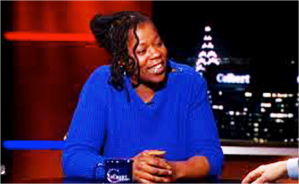
Naquasia LeGrand, 22, a fast food worker in New York City, recently appeared on the Colbert Report.
NEW YORK CITY – The assignment coming together on the table at a mid-Manhattan coffee shop suddenly seemed all encompassing for three fast-food workers. They were collaborating, sharing ideas and rejecting others, for a one-page graphic story that at once would relate the plight of the under-paid and shine optimism and hope for their superhero, “The Unionizer,” in helping workers to demand better wages and working conditions.
Naquasia LeGrand is 22, and was working two KFC jobs until one KFC closed, limiting her to 15 hours of work a week; her hours there are not fixed, so another job is difficult.
Even at $8 an hour now in New York it is difficult to make ends meet at her grandmother’s apartment, where she lives. She had just told her story on the (Stephen) Colbert Report. What she knew for sure, she said, was that a multi-billion-dollar corporation made enough to offer living wages for her co-workers. Continue reading
Fast-Food Workers in My Writing Class
They Don’t Always Come, But When They Do It’s Wow
By Esther Cohen (from Jewish Currents Magazine)
I wish I weren’t, but I am in the you-should-do-this category. While I am not a know-it-all (most things I do not know), I do have the unfortunate You Should Do This Because It’s Good For You quality. As a parent, I tried to sit on it, but often didn’t. Reading, for instance, was the most important thing my son could do. And he didn’t. Some part of me felt that he was therefore doomed. Not the biggest part, but still.
One of the biggest fights we ever had was one day when I came home from work and he was, as always, playing a game on the computer. His playing computer games drove me crazy, and I would picture in my head all these activities he could be doing instead (cooking dinner, creating science experiments, inventing magic tricks, drawing a graphic novel). One day in one of those unfortunate parental What Are You Doing discussions, he who was in seventh grade said, “You’ll never be happy until you come home and find me reading James Joyce. And that will never happen.” I was so pleased that he knew about James Joyce (!) that I dropped the discussion.
I’ve been teaching writing all my life and it’s hard not to have parental expectations of students. They should read what I give them. I’ve taught traditional college classes (I teach Good Stories at Manhattanville College, a former Catholic college with serious good students in Purchase, New York), but most of my classes have been with workers: dishwashers, migrants, nannies. I’m teaching Fast Food Workers now, as part of their national campaign to organize and to change the minimum wage. The class is on Tuesdays. They are usually very late. They don’t read what I give them very often, and they are not particularly good at letting me know when they’ll be at class. They text in class. They even talk on the phone. Continue reading
 WorkersWrite