For Debra Ryan, a Macy’s bedding department worker, the idea of a stable and guaranteed work schedule makes all the difference. A story by NY Times reporter Rachel L. Swarns is here.
For Debra Ryan, a Macy’s bedding department worker, the idea of a stable and guaranteed work schedule makes all the difference. A story by NY Times reporter Rachel L. Swarns is here.
A new ruling by the general counsel of the National Labor Relations Board suggests that McDonald’s Corp. is responsible, in part, for compliance with wage-hour laws and other potential labor issues at its franchises, a decision that should ease union-organizing activities. Click here.
Within each of us, there burns a light of over a billions and billions of souls screaming in agony, of all the pains we hold inside of us
Trying to save those for whom we care and love, including ourselves, and no matter how hard we try, we always get hurt most of all. It is these hard times we call Life.
— Anthony Roman,
Anthony is looking for work at four more fast food outlets after being fired from a McDonalds franchise for lateness. “I’ll work seven days. I’ll do whatever it takes.” He is making time to write and to draw graphic illustrations; he and graphic artist Chris McCamic of Rochester, NY, recently learned that the “Unionizer” figure first appeared publicly in 1911.
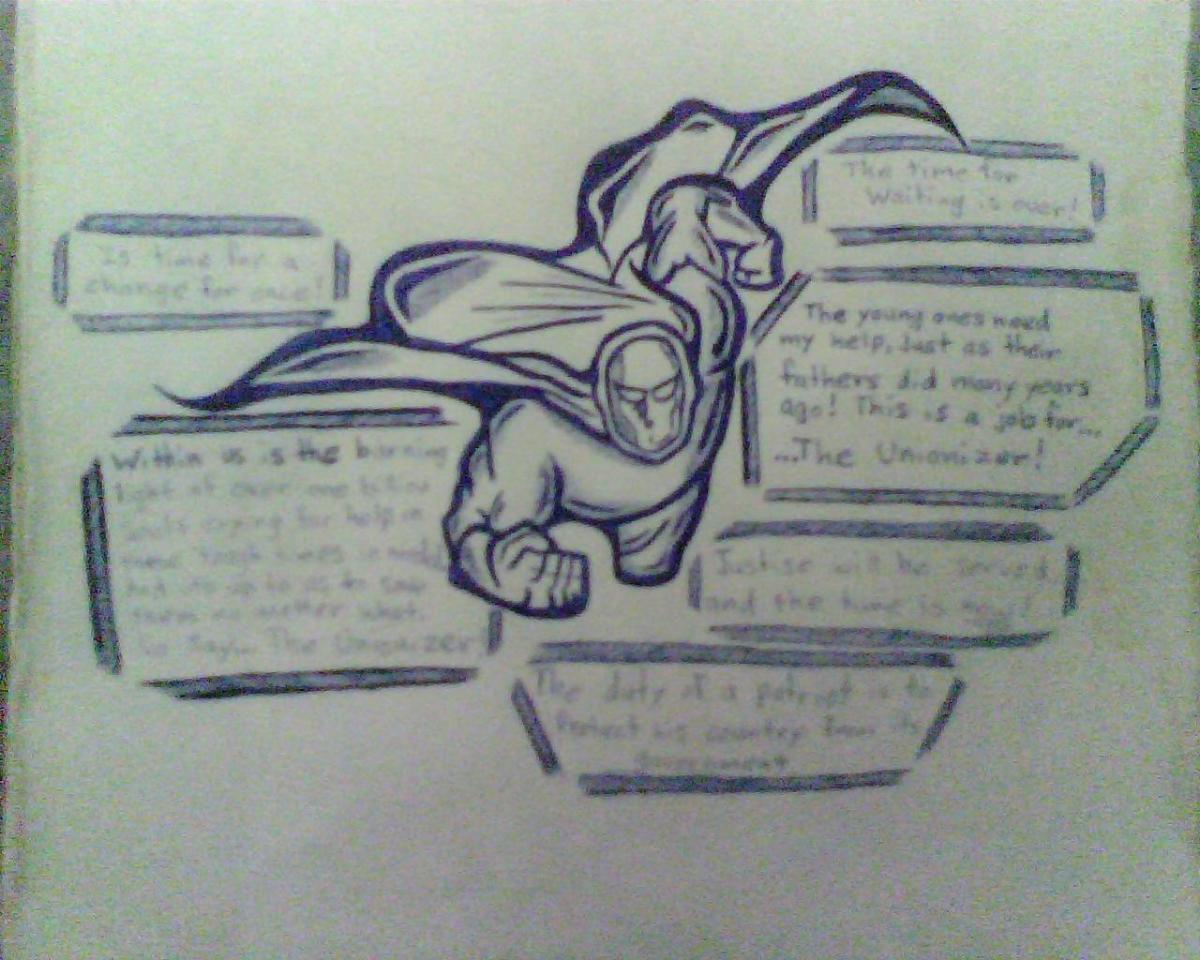
An in-progress Unionizer graphic by Anthony Roman

(Unionizer character drawn by Anthony Roman)
I grew up in the Puerto Rican projects on the Lower East Side, and I have lived my whole life within three blocks. None of it has been easy, but it is where I live, and how I relate to the world.
My mom is there, and I must help her, my girlfriend is there. We just had four babies. She is a hospital nurse. She is staying with her mother in the Bronx, and I’m staying with my mother in the lower east side, and spend a couple nights a week in the Bronx. I have a brother who is just out of jail, and another younger brother who can’t really help. I’m behind in the rent, behind in paying for my phone, which I need to get another job, the kids have been sick. It’s tough.
I was working in three McDonalds, usually getting the job to clean up and close up. They give me multiple jobs at once, which is not fair, but I get them all done. Now I work in one McDonalds, with a new manager who is cutting everyone’s hours. A bunch of people there are just walking away from the job because they are unhappy with the manager. This last week, I was totally alone in the kitchen with a line of customers that went out the door. I want to work as much as possible, but they just don’t want it.
Really, I see myself as an artist. I can draw, I can work with signers and rappers, I can help others. I’ve drawn the Unionizer, our mystery superhero figure who can help fast food workers make things better… he has no face, just a cowl, so no gender or anything to limit who the Unionizer is.
We all grew up with Happy Meals, we understood that they meant goodness and happy times, and we were drawn to want to work at McDonalds to be the people who gave other customers Happy Meals. Somehow, it has not quite worked out that way. The bosses are unfair, the pay is not good, you can’t live on it. The managers do not respect us, the workers. That’s actually the biggest thing, the lack of respect. Dignity. It doesn’t cost anything to be nice to workers. The same people mopping shouldn’t be serving the customers too.
I hope to get a job at the hospital where my girlfriend works, and in a bar at night hauling boxes. I will work seven days if I have to just to pay all the bills. I would like to become the first person in my family to go to college.

Ikea is acting on its own to lift the minimum wage, and it is doing it in a unique way: The U.S. average will be 10.76 an hour, but will be adjusted in different ways for cost of living. Ikea workers in Woodbridge, Va., will get the highest, at $13.22 an hour. Workers in Pittsburgh and West Chester, Ohio, will get the lowest, at $8.69.
The changes go into effect on Jan. 1, 2015. The federal minimum wage is $7.25, though some states and cities pay more.
Massachusetts is on track to have the highest state minimum wage, taking it to $11 per hour by 2017, up from $8 today. Seattle plans to raise the minimum hourly wage to $15 from $9.32. Businesses with fewer than 500 workers have until 2021 to phase it in.
On average, Ikea’s pay change will be a 17% increase, the company said.
Here is one example of the material collected at drivingrichmond.net. Please take a look.
MARCIA SCHMIEGELOW
I grew up on Long Island, in a small town. I ended up going to college in Los Angeles. From there, I migrated to other areas of the country. I’ve always been one to experience everything.
I had driven a school bus in New York. Not only that, I used to hang on the pants of my father. He was a truck driver, he just drove all sorts of vehicles. I was thirteen, driving in the parking lots of the train stations. I had a lot of road experience, so I felt very confident in coming to GRTC.
I was on the Petersburg run for almost two years. Drove the coach bus. That’s the largest bus we have. It’s a dream ride. Not every operator wants to drive that bus.
I was treated like gold. They adored me and I adored them. We bonded. They spoiled me at every celebration—birthday, Christmas-—it didn’t even have to be a celebration. They just poured out gifts to me, because I got them home in time. So that they can have an evening of whatever they needed to do. I never dragged my feet and we worked as a team.
Every three years, there’s an election that takes place for the officers in the union. In June of 2011, we had an election. I ran for the position of financial secretary, amongst four male members. That was my first time ever running for a position.
So it was very intense for me.
I have my own business. And when the position came around, there were several people that approached me. I hadn’t really thought about it. When you have enough people come to you, you start thinking about it a little bit. I thought with the background that I had already, that this should be okay, I should be able to handle this.
One of the people from the Petersburg run, Derek Mountford, he actually assisted me with the campaign. When I told him that I was getting ready to run for office, he said, ‘oh, that’s wonderful.’ He just wanted to help me. He wanted to see it done right. And I said, ‘I am really new to this. Do you have any ideas?’ He was extremely helpful. He came up with little short banners that described who I was, what kind of person I was, and how I would be good for the union.
The attacks on drivers have increased so much. It’s becoming more and more dangerous out there. Nationwide, passengers are attacking drivers. And that’s why the unions nationwide are fighting to have more convictions on people that attack drivers. There need to be heavier laws on that.
I come from a union family. So we realize the importance of union, and the strength of it. The newcomers come in, we try to get them in training so they understand what the union is about and how important it is
Laura Browder has interviewed drivers in Richmond, Va. about their lives and views. Please take a look at drivingrichmond.net for more. This is how Laura Browder explains on her site what she has done.
by Laura Browder
Here’s a well-kept secret: The regional GRTC Transit System is among the most progressive organizations in Richmond. The nonprofit plays a major role in reducing pollution, easing traffic congestion and connecting people to jobs. Its reform-minded leadership is eager to play a larger role. Its unionized bus drivers, which included some of the first waves of black and female drivers, help hold it all together.
And those drivers love their jobs — to a degree unusual for workers in any profession. That’s what I learned through interviews with 16 current and former drivers this summer for an exhibition at the Richmond Street Art Festival, which opens today. Driver Bruce Korusek, who has an amazing collection of GRTC photos and ephemera, took his first bus picture at age 5. Leslie Zink used to pretend as a child to be a bus driver picking up passengers on her bike. “I love to drive,” KaSandra Ellis says. “So, this job was perfect for me. Because I’ll drive from here to Timbuktu.”
And nearly all the drivers I interviewed talked about the relationships they’ve formed with their passengers through the years. “Once I settled into my route, it was wonderful,” driver Deborah Hopkins says. “I got to know people. And they were like family.” Some passengers are so nice, Carl Brown says, “that when it’s hot, they’ll stand at the bus stop with ice cold water and hand out water to the drivers.”
Marcia Schmiegelow formed such tight bonds with her passengers on the Petersburg express that one of them, Derek Mountford, became her campaign manager when she ran for the position of financial secretary of the union.
Union? In a right-to-work state like Virginia? The transit workers of Richmond have been unionized since 1888, and the unionized workers at the GRTC have an unusual relationship with management, in large part because of their most unusual chief executive, Eldridge Coles.
Coles is a legendary figure at GRTC. He started working there in 1967 and is retiring in October — after 46 years on the job. “I worked every job here at GRTC from sweeping the floor to CEO,” he says. “I used to always say, ‘From the back of the bus to the head of the corporation.’
“… Last year, we negotiated a three-year contract. We didn’t call anyone from the outside to work with my staff and the union board and we settled a three-year contract, which is very unusual, without bringing in lawyers. We did it among ourselves. And we did it in a week’s time. I’m very proud of that.”
While the GRTC has changed with the times, the Richmond region hasn’t always kept pace. Korusek showed me a picture of the GRTC class of 1965: all white men, with the exception of one white woman and two black men. Marshall Avent, hired in 1973, says: “I’m told that when African-Americans first started driving the buses that white folks used to call the police on them. Said they stole the bus.”
The women’s movement opened up jobs for people like Jennie Bullock. Still, as she recalls, “Some people didn’t want to ride with the women. When you’d pull in, they would say, ‘Go ahead, I’ll wait for the next bus.’ They’d think that you couldn’t drive.”
Of course, nobody in Richmond today is surprised by the sight of a black or female bus driver. And despite ongoing struggles over funding and proposed route changes, the city government has enacted some of GRTC’s progressive reforms, including the twice-monthly grocery store run for city residents who live in so-called food deserts and lack access to fresh fruits and vegetables. One of the most successful new routes is the Kings Dominion bus. In addition to ferrying fun-loving city residents out for a day of thrills, it carries roughly 100 Richmond young people to summer jobs at the amusement park.
Yet even this innocuous-sounding service has run into resistance from the counties. When GRTC first began the service, Coles recounts, “I received a call from a certain county wanting to know, ‘How did you get permission to come through our county without talking to us?’ I thought that 95 was an interstate highway. Anybody can go up and down it.”
The counties’ resistance to allowing the GRTC and its passengers to move beyond Richmond city boundaries has serious consequences for the region.
“I sit there and watch people get off the Broad Street Six at Willow Lawn, and walk a mile and a half, two miles up Broad Street,” Coles says. “In the wintertime. In the summer. In the heat. There are jobs available that people can’t get to. A lot of them are good jobs, and people would work them if they could get the transportation to get there. They can’t.
“That breaks my heart.”
Laura Browder is a writer, documentary producer and the Tyler and Alice Haynes professor of American studies at the University of Richmond.
Cities are leading the way in tackling minimum wage issues, says a New York Times report. What is most interesting is the argument that connects higher wages and the health of the cities. Click here.
BY TED KOOSER, U.S. POET LAUREATE
Diane Gilliam Fisher, who lives in Ohio, has published a book called Kettle Bottom that portrays the hard life of the West Virginia coal camps. Here is just one of her evocative poems.
Violet’s Wash
Here’s a discussion mixing statistics, experiences and politics about minimum wages by an economist and published in The New York Times. Click here.
 WorkersWrite