Mapping Out the Jimmy John’s Noncompete Requirement for Minimum-Wage Workers

Posted: 10/17/2014 5:55 pm EDT Updated: 10/17/2014 5:59 pm EDT

WASHINGTON — As Huffington Post reported on Monday, many workers at Jimmy John’s sandwich shops have been asked to sign the sort of strict noncompete agreement usually reserved for high-level executives. According to the clause, the worker agrees not to take a job at a competing sandwich shop for a period of two years following employment at Jimmy John’s.

The company’s definition of “competitor” is rather broad: any business that derives 10 percent or more of its revenue from the sale of sandwiches, and that resides within 3 miles of a Jimmy John’s location.

After HuffPost posted a copy of the agreement, many readers wondered just how badly such a contract could restrict workers’ job options in the unlikely situation it were actually enforced. Thanks to Sean Maday, founder of the news mapping site SigActs, we now have an answer to what he calls “an interesting geospatial question.”

Using the addresses of Jimmy John’s roughly 2,000 locations, Maday created a map that reveals the effective blackout areas under the restaurant chain’s noncompete clause. The red circles indicate zones in which a worker who signed the agreement would technically be forbidden to pursue sandwich-related work:

As the map shows, if a franchisee were to enforce the clause — and if a judge were to uphold it in the case of a challenge — a former Jimmy John’s employee could effectively be run out of Chicago, Minneapolis and Denver for the purposes of deli employment. Large swaths of other major metropolitan areas would also be off-limits, and former Jimmy John’s workers would have to head to the fringes of the nation’s college towns if they still wanted to make hoagies.

According to one franchisee, the clause is included in the standard-issue hiring packet distributed by Jimmy John’s corporate offices, although individual store owners decide who must sign it. The franchisee said many owners have jettisoned the language from the hiring packet since it came under scrutiny.

HuffPost still knows of no cases in which a franchisee tried to enforce the clause, which many judges would likely find unreasonable anyway. Several low-level employees, however, did confirm that they were required to sign the noncompete as a condition of employment. Use of the clause has apparently varied from store to store; in some, only management-level employees have been asked to sign.


Continue reading

Walmart Plans to Abandon Minimum Wage

WALMART

The latest sign that the tide is turning in favor of better pay for low-wage workers: Walmart’s CEO on Wednesday announced the company’s intention eventually to abandon the minimum wage.

Walmart chief executive Douglas McMillon told reporters after an investor conference that the company plans to pay all of its workers at a rate higher than the federal minimum of $7.25 per hour. He did not say how much more.

“It is our intention over time that we will be in a situation where we don’t pay minimum wage at all,” McMillon said, according to multiple sources. The move to pay all Walmart employees more than the minimum wage would be largely symbolic: McMillon said less than 1 percent of Walmart’s U.S. employees currently make the minimum wage.

Walmart spokeswoman Brooke Buchanan on Thursday confirmed McMillon’s statement to HuffPost, and said that only 6,000 of the company’s 1.3 million U.S. employees currently make the minimum wage. Buchanan said she couldn’t offer a timeline for when the company would make the change.

When asked what motivated the decision, she said, “We’re looking at how we can take care of our associates and engage them, not only to transform our workforce here at Walmart, but also to transform the workforce here in the U.S.”

McMillon is the latest executive whose comments reflect an apparent trend in corporate America to shift slowly away from the current federal minimum wage. The CEOs of Subway, Dairy Queen and McDonald’s have recently spoken out in favor of a higher federal minimum wage. Ikea increased its lowest pay tier for U.S. workers, bringing a raise to more than 13,000 employees. Overall, surveys have found that a majority of employers think the minimum wage should be higher than it is.

Such an intention is particularly notable coming from the CEO of Walmart, which is the country’s largest private employer, and one that is often accused of paying its workers low wages.

Walmart has disputed such claims, saying its average hourly pay is $12.92, which is significantly higher than the federal minimum. That calculation, however, does not include the wages of its part-time workers.

The announcement came as hundreds of Walmart workers and other low-wage retail and fast-food employees protested on Wednesday and Thursday in four cities, demanding full-time jobs and a minimum wage of $15 an hour.

In New York, protesters picketed the Park Avenue apartment of Walmart heiress Alice Walton, where protesters said they would deliver a petition asking for livable wages.

The battle for a higher guaranteed wage has been fought not just on the street but also in Congress. President Barack Obama has called for raising the minimum wage from $7.25 to $10.10 per hour, but his efforts have met staunch resistance from Republicans.

The minimum wage hasn’t been raised since July 2009, and its purchasing power has fallen dramatically since it peaked in 1968. According to the National Employment Law Project, if the minimum wage had kept pace with inflation, today it would be $10.90 an hour.


Continue reading

The Workers at Potbelly – 3 Reports

Meeting workers in New York City

Tiara, Belle and Ray,

Workers at Potbelly Sandwich Shop, 14th St.

1. By Emma Kilroy

I had to stand on my toes to rest my elbows on the counter at Potbelly. Tiara Reynolds and Belle Tere, the two women behind the counter, were wearing aprons and hats with Potbelly’s earthy green, red, and yellow colors. They had not expected three students to march right into the sandwich shop only minutes after they’d agreed to be interviewed.

Tiara, the shorter of the two, initially was more talkative. She was born and raised in Brooklyn, and still lives in a two family house with her mom, grandmother, aunt and uncle, and their two children. She works at Potbelly to pay for the classes in child psychology that she’s taking. It’s her only job, where she usually works five days a week, five hours per shift. “I like working here because of the people. Sometimes we have parties or theme days, like one day was silly hat day.” She also appreciates the way that the store is run. “We all run the shop together. There are people who are managers, but they let us take turns managing the shifts and have no problem leaving someone like me, I’m just a crew member, in charge.”

Belle shielded her face from the camera (“You didn’t say you were going to take pictures!”), but she opened up as Tiara talked, commenting about where she lived and what she thought about work. Belle started at this particular Potbelly, on W 14th Street, in 2012, but recently left to help open another location in upper Manhattan, closer to where she lives. She sometimes comes back to her original placement to help cover shifts. Belle is hoping to move up from shift manager to general manager, and eventually become Human Resources manager. “I work on and off though,” she explained, “because I went back to school in August. I want to get a bachelors in hospitality and tourism.”

“I LOVE to travel!,” said Belle, suddenly excited and eager to share. She lit up as she talked about the places she has visited. “I’m constantly travelling. I’ll go by myself…I went to the Dominican Republic by myself last summer. I go to South Carolina Continue reading

Brian, Restaurant Worker

Meeting workers in New York City

By Sara Gillooly

Brian from Golden Krust on West 14th Street, who prefers anonymity, said that, “working at a restaurant is very hard and very long.” He feels as if the work there is too much and tends to be boring. Brian has worked at Golden Krust for about a year and previously worked at another restaurant. His normal work schedule is during the day, which he much prefers to the night shift that he used to work at his previous job.

Brian’s education stopped after high school when he moved to America from Jamaica with his entire family. His family thought moving to America would bring new opportunities, which Brian confirmed it did; jobs were incredibly hard to come by in Jamaica. Brian is married with two children, ages eighteen and nineteen. He hopes that one day he will be able to work in other types of jobs in order to try new things.

Brian explained the hardships of transitioning from living in one country to another. In his words, “life is hard everywhere but here you have to do things you’re not used to and it’s different living in a modern first world country. There was a definite transition Continue reading

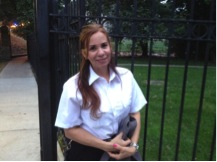
Efrain Arana, Security Guard

comics2

Meeting workers at Fordham

By Emma Kilroy

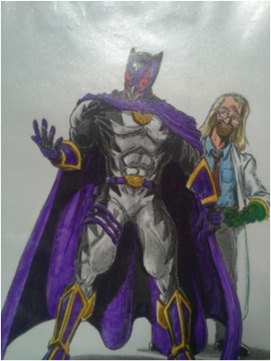
Welcome to Earth. It is the latter-half of the 21st century, about 36 years after World War III and a cosmic event now known as the Renaissance War… The physical global damage from these events was catastrophic, but with the help of alien technology, we were able to rebuild our fallen cities and cleanse our atmosphere. This is the Age of Heroes.

comics1

“What you’re looking at now is a project seventeen years in the making. It’s 96% done. You came at a good time. I’m actually trying to finish it in the next week so I can take it to New York Comic Con and shop it around, try to get people’s opinion.”

The speaker is Efrain Arana, a security guard at the freshman dorm on Fordham’s campus. His job includes monitoring students enter and leaving the residence hall between 10 a.m. and 7 a.m. But to talk with him is to learn of a serious life outside that work.

“I’ve been drawing since I was three years old and I’m thirty-eight now. I didn’t start reading comics heavily until the 1970s, when I could afford them. Then I was spending $40 or $50 a week on comics for about six years. I lost my whole collection in a move. I lost a lot of stuff. But six years of buying $50 of worth of comics per week…”

Efrain is in the zone. He talks in a calm, detached manner as he moves papers between two thick blue binders. He is slipping sheets into plastic sleeves and reordering the pages as I read the introduction. It’s a full-page image of our planet from outer space. Some of the landmasses glow a molten orange, and the yellow letters printed over the image make it look like a warning sign. “Welcome to Earth…”

“It” is the nearly completed first issue of Charge, by DGAF Comics. “I worked security for casinos in Atlantic City for 17 years, and that’s where I met my two partners. I was the new guy. They’d already known each other for a couple of months, and they were training me on the job. But one day they asked me to settle an argument. The one guy was a really big Wolverine fan, and the other guy really liked Superman, so they asked me who I thought would win in a fight. And I said, it doesn’t matter because Batman could beat both of them. And they knew they’d met the right guy. Continue reading

Urel Bernard Baptiste, Security Guard

Meeting workers at Fordham

By Elaina Weber

“I just came to the United States exploring, you know, vacationing,” he said, “and then I forgot to go home.”

Like many immigrants, Urel Bernard Baptiste finds himself away from home without much of a reason other than employment. Bernard, as he is called, stands guard almost every night from 10 P.M. to 6 A.M. at the front desk in Alumni Court South, a residence hall at Fordham University. He stumbled upon this job before the students he safeguards were even born, and has since remained at his post not on purpose, but by chance.

Born in what is now the Commonwealth of Dominica, Bernard grew up on this Caribbean island’s neighbor, Antigua, where he calls home. “Technically I was looking for a job when I came, but not here in New York. I never planned to leave home.” Bernard was offered a job from a man running the department of security at Fordham named Thomas Courtney, who was fond of him back in Antigua, and his wife encouraged him to give it a try. “I wasn’t doing nothing at home anyway,” he admitted, “and she likes it here.”

But after two years of living in New York, Bernard decided he didn’t like it here. He was homesick for his country, his wife, and his four children. One night, he packed up his things, brought his suitcases to the airport, and was ready to fly home for good.

“That night, I forgot my passport. I took a yellow cab all the way back to the Bronx to the people whose house I stayed in and searched, but I couldn’t find it.” Bernard was encouraged to stay one more night until he could get his things together. “And then I thought, what if I wasn’t supposed to go home after all?”

Soon after, Bernard found himself welcoming his wife and children to New York City, where they have lived since. “I will keep working here until my son is done with his education,” Bernard said, “which won’t be long. Then, I’m leaving New York, and leaving this country. I’m going home.”

One of the reasons Bernard is so eager to get away is centered around management decisions to use Summit Security, a third party contractor to supply many security guards at the university. In fact, Bernard is the sole remaining Fordham-trained and Fordham-hired security guard working in the residence halls, and he fears that management “would love to see me [Bernard] go down.” Continue reading

Gina Effah, Restaurant Manager, Cashier

GinaEffahPix

Meeting workers in New York City

By Sara Gillooly

Thirty-year old Gina Effah has been a manager and cashier at Popeye’s on West 14th Street since 2006. Although she lit up when talking about the friendships she’s made while working there, she expressed that her job is not something that she is looking to do permanently. Her immediate plans were sidetracked when she had her first-born baby while still in the process of studying to earn a degree. While at school, Gina’s father passed away, leaving her solely responsible to pay for the remainder of her education.

Gina now has three children while still at school studying radiology part time. Her husband is currently working as a nurse but his salary hasn’t been enough to support the family. She feels as though that even with her husband working, the couple is constantly struggling for money and living paycheck to paycheck. Her job at Popeye’s is a way for her to make a little extra money and push herself through the remainder of school.

Gina feels that her coworkers are like family to her. Still, she mentioned that most people don’t work with her long. A majority of employees at Popeye’s are teen-agers and workers are constantly changing. Because of the fact that Gina is juggling Continue reading

Byron Brooks, Fitness Center Security Guard — and Poet

By Emma Kilroy

Brooks is a tall, older man, with a friendly face under a black cap that reads “Security.” He spins comfortably in his rolling chair, scrolling through pictures and news stories on his tablet and greeting students as they enter the campus fitness center.

“I like this job. I like the atmosphere. It’s very relaxed, but you know, I’m around physical activity, which is positive. Sometimes when I’m straightening everything up in the morning I have to pick up the weights and put them on the rack, so I get in something of a workout that way.”

Brooks works at the center eight hours a day, six days a week, and has been working for Fordham for a little over a year. “I retired early. Before I worked for 27 years as an apartment supervisor in Manhattan. The staff said I was patient and understanding of human needs, but I was always insistent on productivity.”

One thing he misses about his old job is the community. “I know a few people [who work at Fordham], but only in passing and changing shifts. We just cycle in and out every day, whereas at my old job there would be extras. Employee awards, or just parties, where you could get to know one another, or have the chance to share a talent.” These are the events at which Brooks used to sing—“I haven’t had the chance to sing that much since I’m working here so much”—but that’s just the first of the laundry list of talents that he has to share, mostly related to the arts.

“I studied all sorts of different things in high school, but I wasn’t interested in that many of them. I did enough to get by. But when I was done with school and I was self-taught, I started to learn more. When you’re not under the gun you have a way of being more patient with yourself, you can cultivate yourself, so I got into more of the things I really liked. Like I got more into vocabulary. At one point I almost copied the whole dictionary. I had my own notebook, and I wrote ‘Brooks’s Dictionary,’ and I would write out the definitions of words I wanted to know. I would mostly pick words that I heard in conversation and check them.”

Brooks has a slow, particular way of speaking, and often pauses during conversation as if searching for the right word. His logophilia has lent itself to his love of poetry, which is one hobby he can continue while at work. Continue reading

Maria Alvar, Cashier at Subconnection

Meeting workers at Fordham

By Elaina Weber

Maria Alvar is a caterer, a caregiver, a manager, a custodial worker, a nanny, a medical assistant, a factory worker, a mentor to teen girls, a wife, and, above all, a mother. But this year, she is a cashier. During the evenings, she can be found wearing an apron and a large smile behind the counter in a small sandwich shop on Fordham University’s campus, asking how everyone’s day has been and calling each student “baby.”

This job is relatively simple in comparison to the others she has worked. She has served as the lone translator from Dutch to English at a factory, and without Maria, her manager could never have communicated to her coworkers on the line. Maria also served as the manager of factory workers on a similar line, who grew to anticipate her every need and work hard for her approval. At one time, in Holland, she used her diploma in catering to become a manager at a catering company, where she was in charge of managing the staff, making orders, organizing events, all aspects of customer service, and new employee hiring and training. She was the first line of defense in any type of last-minute glitch in plans, and she recalled “running everywhere” on the job, the only expert on the scene. She felt important in these jobs.

“The [catering] job is the most perfect job I did in my whole life,” she recalled, “because they really needed me. Every day.”

But Maria was quick to say her job here behind the register is just as important as any other she has ever worked. She remembers one day on this job as the day she felt more important than any other.

“A boy came in with a face, you know, a sad face. Long and tired, with troubled eyes. I knew he was troubled, but he didn’t say anything about it when I asked how his day is. But I could tell it was schoolwork that was getting him down. So I say to him, ‘Baby, if you don’t want to work with your hands, you have to use your brain.’

“And then the most amazing thing happened on his lips. A smile, and I thought, I did that! He said thanks, mommy, and he said he felt better.” Continue reading

Four Workers from Across Campus


Meeting workers at Fordham

By Andrew O’Grady

Angela Rodriguez, Security Guard

angelerodriguezAngela Rodriguez is a Fordham University security guard, who watches over the entrance to Fordham Prep. She has been working as a guard since 2010 when she first moved to the United State from the Dominican Republic. She now lives in the Bronx and desperately misses her old life in the Dominican Republic. She misses her house, the weather and the people most of all. She moved to be with her family and take care of one of her daughters. Angela has three daughters and they are 31, 25 and 23. The eldest is currently a Jet Blue supervisor and the middle child is currently in medical school trying to become a doctor. The youngest is suffering from mild mental retardation and therefore Angela must take care of her so her daughter can try to live a normal life. Angela also told me she likes her job because its clean, not difficult, and she gets to meet new people, but there are some things that do annoy her. She explained to me that sometimes her supervisor would schedule her for a morning shift right after she works a 4-to-12 a.m. shift. She also told me that sometimes she gets pressured into working a double shift when a guard calls in sick, which really bugs her. Lastly she said she loves to travel and in 10 years dreams of being able to go all over the world.

deborahruselli

Deborah Russelli, Business Manger

Deborah Russelli. Deborah is the business manger for facilities management at Fordham University. Deborah has two kids and loves working at the University because it is family-oriented and has improved her life greatly. Deborah told me her life wasn’t always so easy she told me that growing up in the Bronx was a challenge and she had to overcome a lot of obstacles. At 15, she and two sisters were kicked out Continue reading