Stories by Home Health Workers


See video at https://www.youtube.com/watch?v=ky1e_sv3byE 


Picture

As Executive Director of the 1199 NE Training Fund, I’ve had the privilege of hearing the members tell their stories for many years. I’ve heard uplifting stories and tragic stories. Many stories bring smiles to my face; others leave me sad and shaking my head.
Mercy Osei-Sarbeng, a writer published here, said, “Besides being healthcare workers, we all have personal stories to share, which indeed is for the common good for everyone to hear.” How right she is. I hope that reading this beautiful collection will give you some insight into the world that these committed nursing home workers live in every day. — Steve Bender, Executive Director, 1199 NE Training & Upgrading Fund, Hartford, CT

Publishing With Our Loving Hands fulfills a longtime dream: to mentor worker writers who contribute so much to the social good and to bring their stories to the public. In writing workshops I have listened to many stories about labor. Now they are in print. When workers are given the time to write, read aloud and discuss their stories, the value of their work is reaffirmed. Publishing those stories builds union solidarity and union power, because they show the community the value, honor and heroism of their members. I am proud to help 1199 NE nourish the
creativity and pride of the nursing home workers they represent.

— Timothy Sheard, Hard Ball Press

harrdballpress.com/hgp-authors

Oswaldo Rodriguez, Writer — and Soon, Home Health Worker

“Jenny always wanted to go to school and graduate, but without money it was impossible. So one day he talked to his mother and said, ‘Mother, I am going to school at night.’ He was very young to take night classes; they were really only for adults; but he didn’t care about that. Jenny asked his mother to buy cloth so that he could make his pants and shirt by himself. And even though they didn’t have a sewing machine, Jenny made himself a uniform. It was not perfect, but he didn’t care; he only wanted to go to school. Then Jenny had pants and a shirt, but no shoes, and he said, ‘Mother, just buy me a notebook and pencil; you don’t have to worry about shoes. I can walk without them.’

Excerpt from A Boy Named Jenny”, by Oswaldo Rodriguez, 2012 Literacy Review

(full text at the end of this report)

Oswaldo

by Emma Kilroy

As a young boy in Ecuador, Jenny Oswaldo Rodriguez wanted to go to school. So he made a way. Years later, he sits in a very different kind of classroom, miles from home, and recounts another time that he found a way to get to where he wanted to be—America.

It’s hard to get Oswaldo to open up at first. He is a writer; his stories usually come out of a pen, not his mouth. He answers some basic questions about himself: “I live in Brooklyn. I’m in training there to be a home health aide. The training is provided through the city, through LaGuardia Community College.” When his ESL teacher, Betty, extols his writing abilities, Oswaldo just hugs his binder to his chest and smiles a little. “I just want to hear more stories.” “Well, can you tell us any stories?” “Now?…Okay, I guess. . . this is the story of how I came to the US.” And just like that, we’re in Oswaldo’s world.

“I crossed the border from Mexico into Arizona, but it took three months to get to that point. I had to walk from Ecuador because I couldn’t get a visa—“ “Wait, you walked to Mexico?” “Yes, I walked through the mountains, through Guatemala and Honduras, with four other people.” Continue reading

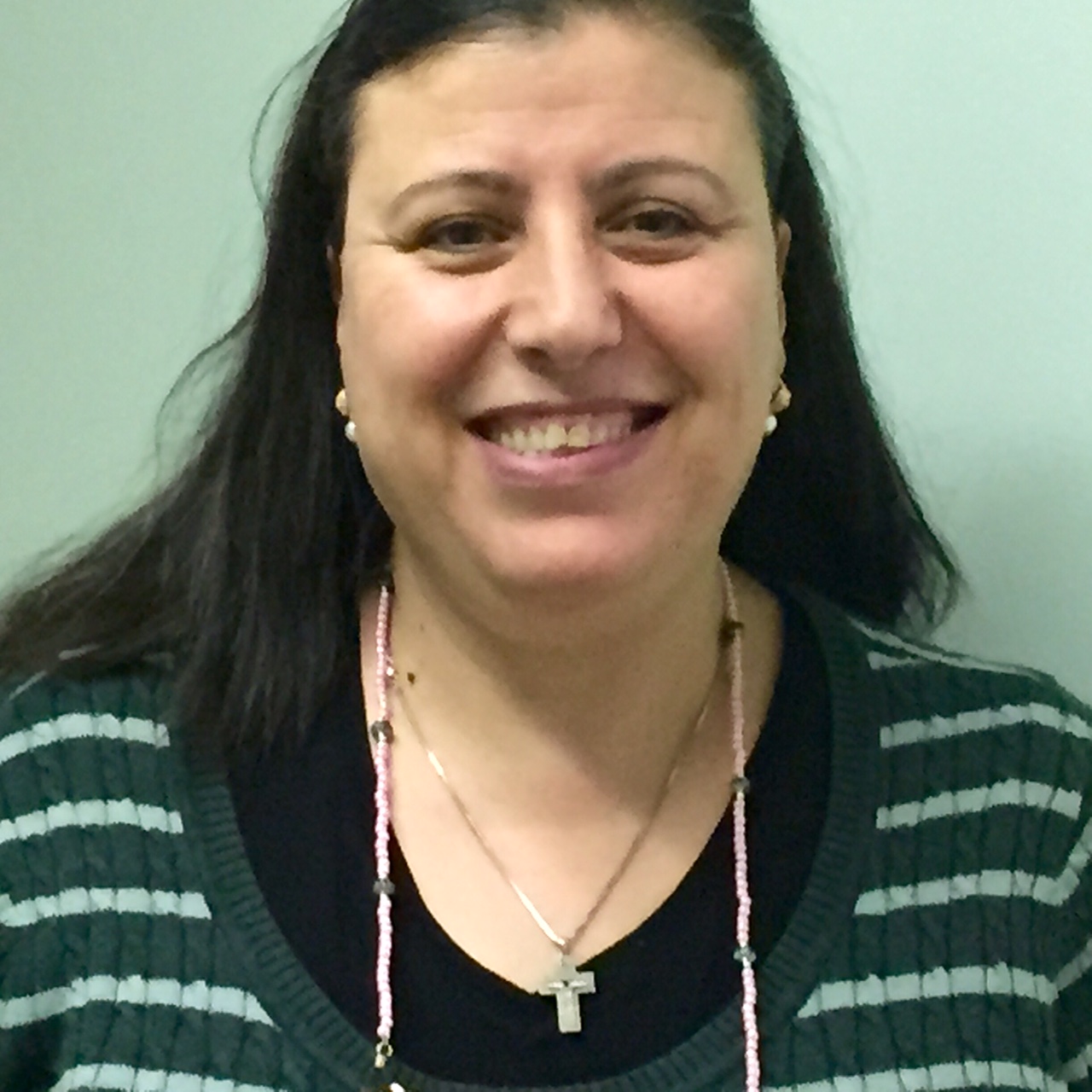
Maha Allawh, Hospital Worker

Maha

Maha Alwah

How to Keep Going

By Andrew O’Grady

Deep in the fashion district of New York City is a large scenic brick building with exquisite architecture and attractive design. The buiding houses the Center for Worker Education (CWE), which provides education for workers within New York. The CWE offers a variety of classes for many who are not native English speakers, allowing them to succeed in the workplace.

The students of this English as a Second Language class were courteous, kindhearted, and caring, and it was easy to be captured by the sense of shared community. They all seemed to relate to one another and understand one another, as if they all shared some secret that they couldn’t tell or explain.

One of the most intriguing and interesting students was a woman named Maha Allawh. Maha is a middle age woman with smooth glossy black hair and a delightful, Cheshire smile that was both inviting and comforting. When she spoke, she exuded elegance and delicacy. Although what attracted me to Maha the most was her incredible story of immigration to America, and the story of hardships she faced and endured trying to integrate and fit into American culture.

Maha comes from Amman, Jordan and in 1994, arrived in the United States with her newlywed husband. Maha explained that when her and her husband married he promised to take her to America. Maha continued to tell the class that this made her very happy and joyous because she said America is the country of freedom. Explaining she was happy to go to America because in America there is no oppression and one can express their political opinion without persecution or pursuit. Continue reading

My Jobs

My Jobs

By Sara Gillooly

During the summer of 2014, I started working for financial services company, R.R. Donnelley, as part of their hospitality team making $15/hour full time. Every morning I would wake up at 6:15 AM at my Midtown Intern Housing and start my 45-minute commute downtown to the World Trade Center to start my day promptly at 7:30 AM. My morning responsibilities included making coffee for each part of the office, putting out a breakfast buffet for any clients scheduled to arrive, and organizing and refilling any snacks and beverages in all of the 12 client rooms. As the day progressed, I would be responsible for ordering and setting up lunch for any clients in-house as well as washing their plates and silverware and cleaning up any trash left in client rooms throughout the office.

On days with no clients I would find myself standing in the kitchen staring out the window to pass the time. There was nowhere for me to sit and quite honestly, not enough for me to do to occupy my eight hours each day. I started bringing a book to work on days I anticipated would be slow but my boss wasn’t crazy about the way I planned to keep myself busy. He started giving me busy work when he realized that I was just standing around most of the day. I then was asked to do a wide array of tasks including laundry, checking the office for broken computers, running errands to get our office cable boxes fixed, buying milk for the office, and carrying large bags of bottled beverages to corporate offices all over the city when the company would have off-premise meetings my boss needed to attend to. Continue reading

Maria Cabrera, 57, Plastics Worker

maria cabrera

By Sara Gillooly

It was a rainy Wednesday afternoon, an uphill and wet walk up Fordham Road to meet with Maria Cabrera at a local Dunkin Donuts. Maria, 57, works for Gary Plastics, one of the largest plastic companies in the United States to manufactures plastic bottles. Maria came from the Dominican Republic to The Bronx, where she lives, divorced, with one adult son and one young granddaughter.

Maria has been working at Gary for 22 years, operating various machines that assemble different plastic items. Her job keeps her sitting in one place for eight hours a day, pushing a button with two ten-minute breaks, five days a week. She is a member of Workers United, Service Employees Union International.

Every morning she wakes up at 6:15 AM and takes two buses to work, a commute of about one hour. During our conversation, Maria told me that if she is late to work once or twice, it is not a big deal, but any more than that and she would be reprimanded. For the most part, Maria gets along with the people she works with and feels like she can hold conversations with them throughout the workday as long as she is being productive at the same time. She wishes that her and her co-workers could listen to music on the job but in the past, they haven’t been able to agree on what music to play and people became too pre-occupied with dancing around the work place and weren’t able to get anything else done. Continue reading

My Experiences Talking with Workers

By Emma Kilroy

Our first assignment as a part of this internship gathering worker stories was the hardest—interviewing people who work at Fordham.

I believe that the people who work where you live are some of the most important to get to know, but I found that out pre-established relationship actually made it difficult for me to approach the workers at Fordham. I’d like to think that I’m at pretty friendly to the workers that I encounter on a daily basis at school, but I was surprised and embarrassed when I embarked on this assignment to find how little I really knew any of them.

One woman, a guard named Myrtle, whom I greeted every day last year on my way into the field house for track practice, looked so embarrassed and apologetic when I asked her for an interview that she couldn’t look me in the eye. “No, no. . . too many students asking over the years,” she murmured, shaking her head. I guessed that she’s been interviewed before for similar assignments or school newspaper reports, and didn’t want to be treated as a project.

I found myself ashamed that I had only really wanted to get to know her when prompted to think about it by this internship. This pattern repeated itself with a few more of the workers I approached—the shaking of the head and glancing away that caused me to quickly apologize and excuse myself. I persisted because once I recognized that this barrier was present, it felt even more important to try to break through. Continue reading

San Francisco Votes $15 Minimum Wage; Votes in 4 States Advance Wages

Clare O’Connor Forbes Staff, Forbes Magazine

11/05/2014 @ 8:52AM

Low-wage retail and fast food workers can claim a second victory in a fight for a $15 minimum wage that has resulted in strikes, protests and arrests over the last two years.

On Tuesday, San Francisco voters approved a minimum wage of $15 across the city, joining Seattle, which raised its pay to the same sum in June. As in Seattle, San Francisco workers will see their wage increase incrementally. By next May, it’ll hit $12.25, climbing to $13 in 2016. By 2018, it’ll be $15, meaning a full-time minimum wage worker in the liberal California city can expect to make $31,000 a year.

Minimum wage also got a boost in four traditionally Republican states following Tuesday’s midterm elections, with voters approving ballot measures in Alaska, Arkansas, Nebraska and South Dakota.

In Alaska, low-wage workers will see their hourly pay boosted to $9.75 by 2016 (the federal minimum remains $7.25). In Arkansas, that number will be $8.50, while Nebraska voters approved a new hourly salary of $9. South Dakota workers will see their wage upped to $8.50 next year.

These red state wage hikes follow a campaign by President Obama to see the federal minimum raised to $10.10 per hour. The bill died on the Senate floor in April. Continue reading

4 States Voting on Minimum Wage Hikes

Huffington Post 10/31/2014

WASHINGTON — Republicans in Congress may be in no mood to hike the minimum wage, but four conservative-leaning states are poised to do it on their own next week.

Initiatives to raise the minimum wage appear on the ballot in Alaska, Arkansas, Nebraska and South Dakota on Tuesday. Alaska, Arkansas and South Dakota all have Republican-controlled legislatures, and Nebraska is solidly red despite the official lack of party affiliation in its statehouse.

Recent polls have shown strong support for each of these ballot initiatives. That should come as no surprise. The idea of hiking the wage floor tends to receive bipartisan backing among Americans, with around two-thirds of voters saying they favor such proposals in most surveys.

“We’re expecting them all to go through,” said Tsedeye Gebreselassie, an attorney with the National Employment Law Project Action Fund, which advocates for a higher minimum wage. “I would be shocked if it didn’t go through in any of the states.”

If the ballot measures pass, they will mark a milestone of sorts for the minimum wage.

Twenty-two states and the District of Columbia currently have their own minimum wage set higher than the federal level of $7.25 per hour, and Maryland and Hawaii will soon join them thanks to laws passed earlier this year. Of the four states weighing proposals next week, three of them — Arkansas, Nebraska and South Dakota — have their wage floors set at just $7.25.

If all four ballot measures make it through, a majority of states will have effectively determined that the federal minimum wage set by Congress is too low. They would include large swaths of the U.S. where the cost of living is generally lower than average — a common argument among conservatives against raising the federal wage floor.

Alaska’s measure would hike the state’s minimum wage from $7.75 to $9.75 by 2016. Arkansas’ minimum wage would go to $8.50 by 2017, Nebraska’s to $9 by 2016, and South Dakota’s to $8.50 by next year. The measures in Alaska and South Dakota would also tie the minimum wage to an inflation index, so that the wage floor would rise with the cost of living. Ten states have already indexed their minimum wages.

Illinois also has a minimum wage measure on the ballot Tuesday, though it’s nonbinding and merely allows voters to send a message to state lawmakers.

The last time the country saw so many minimum-wage ballot initiatives in a midterm election was 2006, when there were six — in Arizona, Colorado, Missouri, Montana, Nevada and Ohio. The fate of those measures bodes well for the backers of this year’s initiatives: Every one of them passed.

Democrats in Congress have proposed raising the federal minimum wage to $10.10 and tying it to inflation, a measure backed by President Barack Obama. House Republicans have so far refused to give the bill a vote, however, and Senate Democrats haven’t managed to round up enough votes to overcome a GOP filibuster. If Republicans win control of the Senate next week, the prospects of a federal minimum wage hike anytime soon will become even dimmer.

Given the gridlock in Washington, the president has urged cities and states to bypass Congress and raise their own minimum wages.

“To every mayor, governor and state legislator in America, I say, ‘You don’t have to wait for Congress to act,'” Obama said in his State of the Union speech in January. “Americans will support you if you take this on.”

Continue reading

Doctor Says No Overtime; Pregnant Woman’s Boss Says No Job

The New York Times OCT. 19, 2014

Angelica Valencia put the doctor’s note in her pocketbook and stepped out of her apartment in the early morning darkness. Then she started praying.

She prayed on the crowded buses and on the subway train that carried her from Queens into the Bronx to the potato-packing plant where she worked. “Please let me keep my job,” she repeated during her two-hour commute. “Please let everything work out.”

She punched in at 7:30 a.m. and handed her manager the note. Then Ms. Valencia, who was 39 and three months pregnant, went straight to work. Last year, she had a miscarriage. This time, her doctor said, she was once again high risk. No overtime, he ordered, just eight hours a day.

But it was the busy season at the Fierman Produce Exchange, and her bosses had already told her she had to work overtime. So as Ms. Valencia sorted potatoes on that Aug. 8 morning, she worried: How would her supervisors respond to the doctor’s note? At the end of her shift, would she still have a job?

This month is the first anniversary of the Pregnant Workers Fairness Act, which was signed into law by former Mayor Michael R. Bloomberg on Oct. 2, 2013. The law, which went into effect in January, represents a big step forward for working women. Continue reading