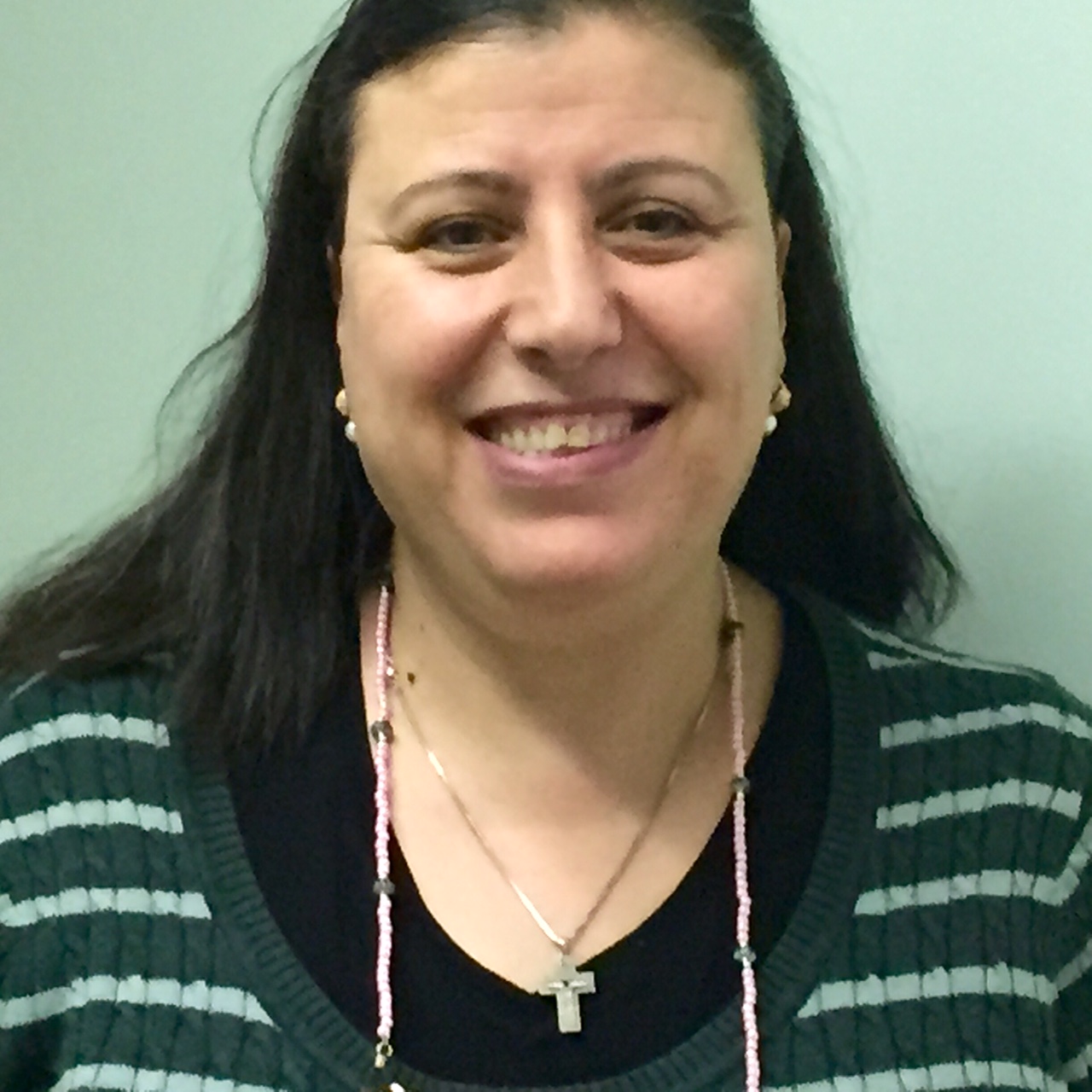
Maha Allawh, Hospital Worker

Maha

Maha Alwah

How to Keep Going

By Andrew O’Grady

Deep in the fashion district of New York City is a large scenic brick building with exquisite architecture and attractive design. The buiding houses the Center for Worker Education (CWE), which provides education for workers within New York. The CWE offers a variety of classes for many who are not native English speakers, allowing them to succeed in the workplace.

The students of this English as a Second Language class were courteous, kindhearted, and caring, and it was easy to be captured by the sense of shared community. They all seemed to relate to one another and understand one another, as if they all shared some secret that they couldn’t tell or explain.

One of the most intriguing and interesting students was a woman named Maha Allawh. Maha is a middle age woman with smooth glossy black hair and a delightful, Cheshire smile that was both inviting and comforting. When she spoke, she exuded elegance and delicacy. Although what attracted me to Maha the most was her incredible story of immigration to America, and the story of hardships she faced and endured trying to integrate and fit into American culture.

Maha comes from Amman, Jordan and in 1994, arrived in the United States with her newlywed husband. Maha explained that when her and her husband married he promised to take her to America. Maha continued to tell the class that this made her very happy and joyous because she said America is the country of freedom. Explaining she was happy to go to America because in America there is no oppression and one can express their political opinion without persecution or pursuit. Continue reading
My Jobs

My Jobs

By Sara Gillooly

During the summer of 2014, I started working for financial services company, R.R. Donnelley, as part of their hospitality team making $15/hour full time. Every morning I would wake up at 6:15 AM at my Midtown Intern Housing and start my 45-minute commute downtown to the World Trade Center to start my day promptly at 7:30 AM. My morning responsibilities included making coffee for each part of the office, putting out a breakfast buffet for any clients scheduled to arrive, and organizing and refilling any snacks and beverages in all of the 12 client rooms. As the day progressed, I would be responsible for ordering and setting up lunch for any clients in-house as well as washing their plates and silverware and cleaning up any trash left in client rooms throughout the office.

On days with no clients I would find myself standing in the kitchen staring out the window to pass the time. There was nowhere for me to sit and quite honestly, not enough for me to do to occupy my eight hours each day. I started bringing a book to work on days I anticipated would be slow but my boss wasn’t crazy about the way I planned to keep myself busy. He started giving me busy work when he realized that I was just standing around most of the day. I then was asked to do a wide array of tasks including laundry, checking the office for broken computers, running errands to get our office cable boxes fixed, buying milk for the office, and carrying large bags of bottled beverages to corporate offices all over the city when the company would have off-premise meetings my boss needed to attend to. Continue reading

Maria Cabrera, 57, Plastics Worker

maria cabrera

By Sara Gillooly

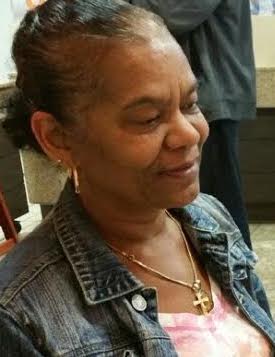
It was a rainy Wednesday afternoon, an uphill and wet walk up Fordham Road to meet with Maria Cabrera at a local Dunkin Donuts. Maria, 57, works for Gary Plastics, one of the largest plastic companies in the United States to manufactures plastic bottles. Maria came from the Dominican Republic to The Bronx, where she lives, divorced, with one adult son and one young granddaughter.

Maria has been working at Gary for 22 years, operating various machines that assemble different plastic items. Her job keeps her sitting in one place for eight hours a day, pushing a button with two ten-minute breaks, five days a week. She is a member of Workers United, Service Employees Union International.

Every morning she wakes up at 6:15 AM and takes two buses to work, a commute of about one hour. During our conversation, Maria told me that if she is late to work once or twice, it is not a big deal, but any more than that and she would be reprimanded. For the most part, Maria gets along with the people she works with and feels like she can hold conversations with them throughout the workday as long as she is being productive at the same time. She wishes that her and her co-workers could listen to music on the job but in the past, they haven’t been able to agree on what music to play and people became too pre-occupied with dancing around the work place and weren’t able to get anything else done. Continue reading

My Experiences Talking with Workers

By Emma Kilroy

Our first assignment as a part of this internship gathering worker stories was the hardest—interviewing people who work at Fordham.

I believe that the people who work where you live are some of the most important to get to know, but I found that out pre-established relationship actually made it difficult for me to approach the workers at Fordham. I’d like to think that I’m at pretty friendly to the workers that I encounter on a daily basis at school, but I was surprised and embarrassed when I embarked on this assignment to find how little I really knew any of them.

One woman, a guard named Myrtle, whom I greeted every day last year on my way into the field house for track practice, looked so embarrassed and apologetic when I asked her for an interview that she couldn’t look me in the eye. “No, no. . . too many students asking over the years,” she murmured, shaking her head. I guessed that she’s been interviewed before for similar assignments or school newspaper reports, and didn’t want to be treated as a project.

I found myself ashamed that I had only really wanted to get to know her when prompted to think about it by this internship. This pattern repeated itself with a few more of the workers I approached—the shaking of the head and glancing away that caused me to quickly apologize and excuse myself. I persisted because once I recognized that this barrier was present, it felt even more important to try to break through. Continue reading

The Workers at Potbelly – 3 Reports

Meeting workers in New York City

Tiara, Belle and Ray,

Workers at Potbelly Sandwich Shop, 14th St.

1. By Emma Kilroy

I had to stand on my toes to rest my elbows on the counter at Potbelly. Tiara Reynolds and Belle Tere, the two women behind the counter, were wearing aprons and hats with Potbelly’s earthy green, red, and yellow colors. They had not expected three students to march right into the sandwich shop only minutes after they’d agreed to be interviewed.

Tiara, the shorter of the two, initially was more talkative. She was born and raised in Brooklyn, and still lives in a two family house with her mom, grandmother, aunt and uncle, and their two children. She works at Potbelly to pay for the classes in child psychology that she’s taking. It’s her only job, where she usually works five days a week, five hours per shift. “I like working here because of the people. Sometimes we have parties or theme days, like one day was silly hat day.” She also appreciates the way that the store is run. “We all run the shop together. There are people who are managers, but they let us take turns managing the shifts and have no problem leaving someone like me, I’m just a crew member, in charge.”

Belle shielded her face from the camera (“You didn’t say you were going to take pictures!”), but she opened up as Tiara talked, commenting about where she lived and what she thought about work. Belle started at this particular Potbelly, on W 14th Street, in 2012, but recently left to help open another location in upper Manhattan, closer to where she lives. She sometimes comes back to her original placement to help cover shifts. Belle is hoping to move up from shift manager to general manager, and eventually become Human Resources manager. “I work on and off though,” she explained, “because I went back to school in August. I want to get a bachelors in hospitality and tourism.”

“I LOVE to travel!,” said Belle, suddenly excited and eager to share. She lit up as she talked about the places she has visited. “I’m constantly travelling. I’ll go by myself…I went to the Dominican Republic by myself last summer. I go to South Carolina Continue reading

Efrain Arana, Security Guard

comics2

Meeting workers at Fordham

By Emma Kilroy

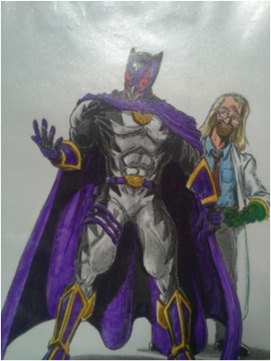
Welcome to Earth. It is the latter-half of the 21st century, about 36 years after World War III and a cosmic event now known as the Renaissance War… The physical global damage from these events was catastrophic, but with the help of alien technology, we were able to rebuild our fallen cities and cleanse our atmosphere. This is the Age of Heroes.

comics1

“What you’re looking at now is a project seventeen years in the making. It’s 96% done. You came at a good time. I’m actually trying to finish it in the next week so I can take it to New York Comic Con and shop it around, try to get people’s opinion.”

The speaker is Efrain Arana, a security guard at the freshman dorm on Fordham’s campus. His job includes monitoring students enter and leaving the residence hall between 10 a.m. and 7 a.m. But to talk with him is to learn of a serious life outside that work.

“I’ve been drawing since I was three years old and I’m thirty-eight now. I didn’t start reading comics heavily until the 1970s, when I could afford them. Then I was spending $40 or $50 a week on comics for about six years. I lost my whole collection in a move. I lost a lot of stuff. But six years of buying $50 of worth of comics per week…”

Efrain is in the zone. He talks in a calm, detached manner as he moves papers between two thick blue binders. He is slipping sheets into plastic sleeves and reordering the pages as I read the introduction. It’s a full-page image of our planet from outer space. Some of the landmasses glow a molten orange, and the yellow letters printed over the image make it look like a warning sign. “Welcome to Earth…”

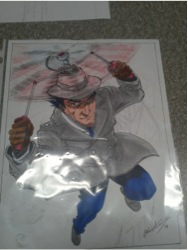
“It” is the nearly completed first issue of Charge, by DGAF Comics. “I worked security for casinos in Atlantic City for 17 years, and that’s where I met my two partners. I was the new guy. They’d already known each other for a couple of months, and they were training me on the job. But one day they asked me to settle an argument. The one guy was a really big Wolverine fan, and the other guy really liked Superman, so they asked me who I thought would win in a fight. And I said, it doesn’t matter because Batman could beat both of them. And they knew they’d met the right guy. Continue reading

Urel Bernard Baptiste, Security Guard

Meeting workers at Fordham

By Elaina Weber

“I just came to the United States exploring, you know, vacationing,” he said, “and then I forgot to go home.”

Like many immigrants, Urel Bernard Baptiste finds himself away from home without much of a reason other than employment. Bernard, as he is called, stands guard almost every night from 10 P.M. to 6 A.M. at the front desk in Alumni Court South, a residence hall at Fordham University. He stumbled upon this job before the students he safeguards were even born, and has since remained at his post not on purpose, but by chance.

Born in what is now the Commonwealth of Dominica, Bernard grew up on this Caribbean island’s neighbor, Antigua, where he calls home. “Technically I was looking for a job when I came, but not here in New York. I never planned to leave home.” Bernard was offered a job from a man running the department of security at Fordham named Thomas Courtney, who was fond of him back in Antigua, and his wife encouraged him to give it a try. “I wasn’t doing nothing at home anyway,” he admitted, “and she likes it here.”

But after two years of living in New York, Bernard decided he didn’t like it here. He was homesick for his country, his wife, and his four children. One night, he packed up his things, brought his suitcases to the airport, and was ready to fly home for good.

“That night, I forgot my passport. I took a yellow cab all the way back to the Bronx to the people whose house I stayed in and searched, but I couldn’t find it.” Bernard was encouraged to stay one more night until he could get his things together. “And then I thought, what if I wasn’t supposed to go home after all?”

Soon after, Bernard found himself welcoming his wife and children to New York City, where they have lived since. “I will keep working here until my son is done with his education,” Bernard said, “which won’t be long. Then, I’m leaving New York, and leaving this country. I’m going home.”

One of the reasons Bernard is so eager to get away is centered around management decisions to use Summit Security, a third party contractor to supply many security guards at the university. In fact, Bernard is the sole remaining Fordham-trained and Fordham-hired security guard working in the residence halls, and he fears that management “would love to see me [Bernard] go down.” Continue reading

Gina Effah, Restaurant Manager, Cashier

GinaEffahPix

Meeting workers in New York City

By Sara Gillooly

Thirty-year old Gina Effah has been a manager and cashier at Popeye’s on West 14th Street since 2006. Although she lit up when talking about the friendships she’s made while working there, she expressed that her job is not something that she is looking to do permanently. Her immediate plans were sidetracked when she had her first-born baby while still in the process of studying to earn a degree. While at school, Gina’s father passed away, leaving her solely responsible to pay for the remainder of her education.

Gina now has three children while still at school studying radiology part time. Her husband is currently working as a nurse but his salary hasn’t been enough to support the family. She feels as though that even with her husband working, the couple is constantly struggling for money and living paycheck to paycheck. Her job at Popeye’s is a way for her to make a little extra money and push herself through the remainder of school.

Gina feels that her coworkers are like family to her. Still, she mentioned that most people don’t work with her long. A majority of employees at Popeye’s are teen-agers and workers are constantly changing. Because of the fact that Gina is juggling Continue reading

Byron Brooks, Fitness Center Security Guard — and Poet

By Emma Kilroy

Brooks is a tall, older man, with a friendly face under a black cap that reads “Security.” He spins comfortably in his rolling chair, scrolling through pictures and news stories on his tablet and greeting students as they enter the campus fitness center.

“I like this job. I like the atmosphere. It’s very relaxed, but you know, I’m around physical activity, which is positive. Sometimes when I’m straightening everything up in the morning I have to pick up the weights and put them on the rack, so I get in something of a workout that way.”

Brooks works at the center eight hours a day, six days a week, and has been working for Fordham for a little over a year. “I retired early. Before I worked for 27 years as an apartment supervisor in Manhattan. The staff said I was patient and understanding of human needs, but I was always insistent on productivity.”

One thing he misses about his old job is the community. “I know a few people [who work at Fordham], but only in passing and changing shifts. We just cycle in and out every day, whereas at my old job there would be extras. Employee awards, or just parties, where you could get to know one another, or have the chance to share a talent.” These are the events at which Brooks used to sing—“I haven’t had the chance to sing that much since I’m working here so much”—but that’s just the first of the laundry list of talents that he has to share, mostly related to the arts.

“I studied all sorts of different things in high school, but I wasn’t interested in that many of them. I did enough to get by. But when I was done with school and I was self-taught, I started to learn more. When you’re not under the gun you have a way of being more patient with yourself, you can cultivate yourself, so I got into more of the things I really liked. Like I got more into vocabulary. At one point I almost copied the whole dictionary. I had my own notebook, and I wrote ‘Brooks’s Dictionary,’ and I would write out the definitions of words I wanted to know. I would mostly pick words that I heard in conversation and check them.”

Brooks has a slow, particular way of speaking, and often pauses during conversation as if searching for the right word. His logophilia has lent itself to his love of poetry, which is one hobby he can continue while at work. Continue reading

Maria Alvar, Cashier at Subconnection

Meeting workers at Fordham

By Elaina Weber

Maria Alvar is a caterer, a caregiver, a manager, a custodial worker, a nanny, a medical assistant, a factory worker, a mentor to teen girls, a wife, and, above all, a mother. But this year, she is a cashier. During the evenings, she can be found wearing an apron and a large smile behind the counter in a small sandwich shop on Fordham University’s campus, asking how everyone’s day has been and calling each student “baby.”

This job is relatively simple in comparison to the others she has worked. She has served as the lone translator from Dutch to English at a factory, and without Maria, her manager could never have communicated to her coworkers on the line. Maria also served as the manager of factory workers on a similar line, who grew to anticipate her every need and work hard for her approval. At one time, in Holland, she used her diploma in catering to become a manager at a catering company, where she was in charge of managing the staff, making orders, organizing events, all aspects of customer service, and new employee hiring and training. She was the first line of defense in any type of last-minute glitch in plans, and she recalled “running everywhere” on the job, the only expert on the scene. She felt important in these jobs.

“The [catering] job is the most perfect job I did in my whole life,” she recalled, “because they really needed me. Every day.”

But Maria was quick to say her job here behind the register is just as important as any other she has ever worked. She remembers one day on this job as the day she felt more important than any other.

“A boy came in with a face, you know, a sad face. Long and tired, with troubled eyes. I knew he was troubled, but he didn’t say anything about it when I asked how his day is. But I could tell it was schoolwork that was getting him down. So I say to him, ‘Baby, if you don’t want to work with your hands, you have to use your brain.’

“And then the most amazing thing happened on his lips. A smile, and I thought, I did that! He said thanks, mommy, and he said he felt better.” Continue reading