Bobs, Manager of King’s Value Store

By Megan Caldwell

Among all the other changes, moving into a college room means filling your new room with lamps, desks, chairs, mirrors and, of course, an array of tacky wall decor to feel cozy.

I knew I could always buy such things when I arrived at Fordham University in the Bronx. Moving into Finlay Hall, I ran across the street to the closest store I could find to buy myself a mirror, some wall tacks and a disco ball. This is when I discovered the King’s Value Store, commonly referred to by students as the “dollar store”.

Wandering into this store, I quickly realized what a hidden gem this place was. Everything one could need in life was located at this tiny dollar store. As my trips there have become routine, I spoke with Bobs, the manager of the store.

Bobs has been working at the Value Store for a few months now, planning the daily schedule of employees, checking the stock, maintaining the store’s budget and reporting to senior management.

Feeling nervous and shy, Bobs slowly began to share with me his story. Having grown up on Fordham Road in the Bronx, Bobs hopes to raise his family here and give his 4-month-old daughter the life he never had. Having dropped out of middle school to help support his family, Bobs never pursued higher education.

Living in the Bronx has allowed him to remain close with his family, all 2,000 of them. Yes, that’s right, 2,000 uncles, aunts and cousins! Originally from Ghana, his family has slowly made their way to the United States over the past few generations and now a majority of them live right here in the Bronx. Extremely proud of his heritage, Bobs hopes to one day take his daughter to Ghana so that she too can appreciate the sacrifices made by earlier generations. Continue reading
Loyola Hall Security Guard

By Siobhan Loughran

February 12, 2015

At my freshman residence hall at Fordham University, there are three security officers who rotate nights on duty through the week. They relieve the student-worker desk assistants at 10 p.m. every night, and don’t leave until 6 a.m. the next morning. Passing them every night with a friendly hello doesn’t feel like enough. So unable to sleep on a cold February night, I paid a visit around 1:30 a.m. to the security guard on duty. She immediately said, “I hope you’re not going outside like that,” referring to my outfit choice: a t-shirt and sandals. Asking that I not share her name online, she kindly began sharing her story with me.

She has been a security officer for nearly sixteen years and has worked at multiple different sites, including hospitals and commercial office buildings. She was with one company for many years, but it merged with another; she has been with the company that supplies Fordham University’s security officers for three years now. Fordham is her first time working school campus facilities and she has held her position for five months and one week.

While humbly acknowledging her position as “the baby” on the Fordham team, she is looking to work her way up the ladder to leadership roles similar to the ones she held in past jobs. She considers her position a good one, and it doesn’t hurt that her home is only five bus stops away. Overall, she’s happy working at Fordham. She enjoys the privileges of her position and the opportunity to work toward more. She also gets along well her co-workers and her supervisors.

A little hesitant at first about what to share, she broke into stride and an easy smile when she began talking about her affinity for interacting with people. While she prided herself on being alert and unafraid to intervene when kids get inappropriately loud in the dorm or begin misbehaving in any other sense, I think what makes her a good security guard is that she sincerely cares for the well-being of other people. She lit up when talking about the importance of reciprocal respect with students and making sure they trust her, no matter the situation. She’s always open to listening to students who want to share their problems and thinks it’s really dangerous when kids hide what they’re going through.

As a grandmother of a couple of teenagers, she understands how someone can only guess what kids are going through; it’s impossible to truly know without their willingness to share. She likes that she switches her shifts between one freshman dorm and two sophomore dorms, since she gets to know more students that way. She called it exciting to work here because she gets to see college in a way that she normally only sees on TV. She admitted that changing her routines has been a little difficult, but noted that adjustment is a part of life. She is coming along on the new sleep schedule, which is very different from that of her previous 4PM to 12AM job.

She feels lucky the position at Fordham was open and she was able to go straight into a five-day work schedule. But it was probably more than luck. Her experience, her credentials, and the fulfillment she feels from protecting us students (usually from our own foolishness) make her the best woman for the job. I think she put it best when she smiled and said, “Interacting with people… It’s in my nature.”


Continue reading

Inside the Harlem Market

2014-12-06 14.21.36

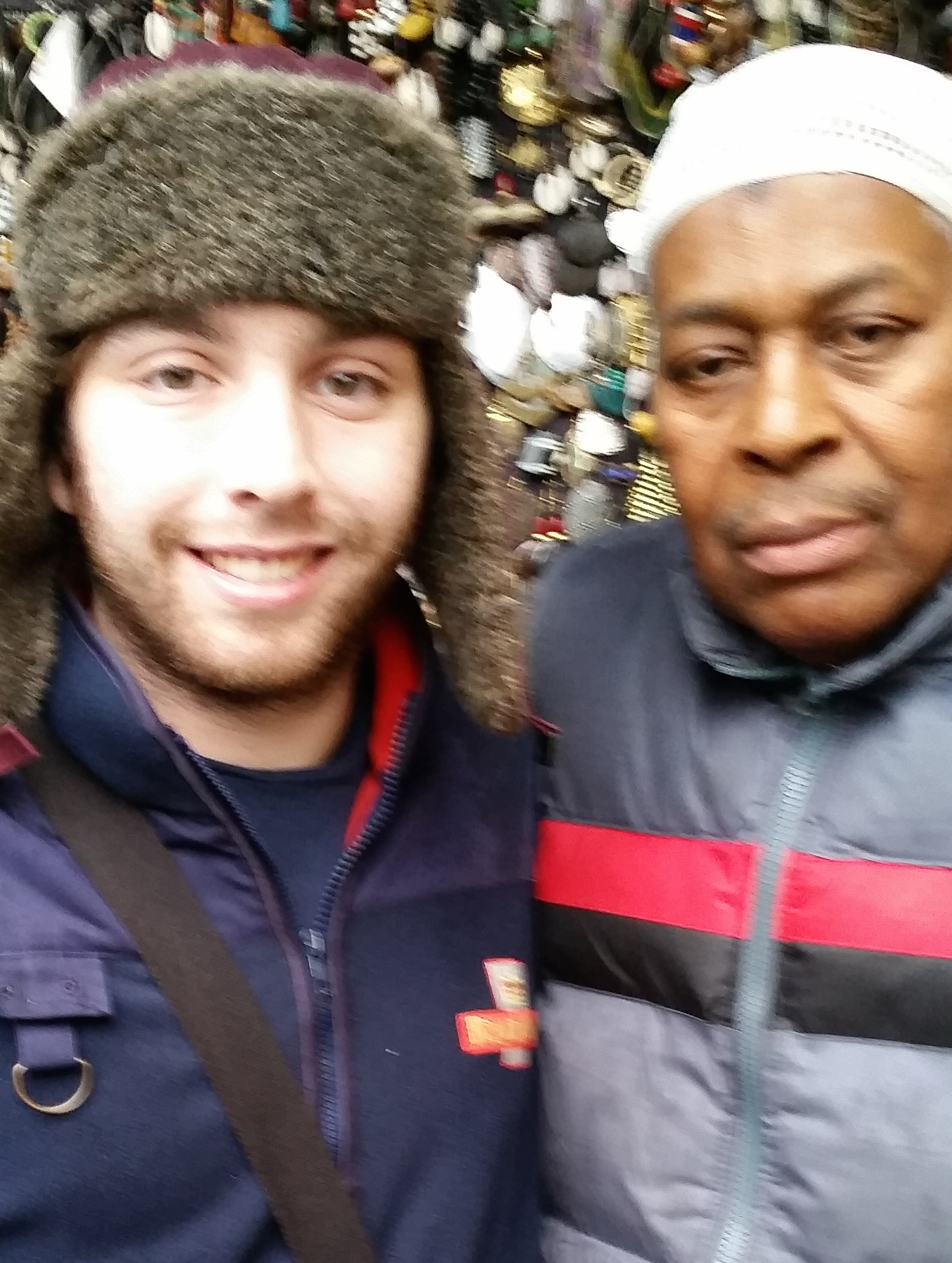
By Alex Mold, seen here with shopkeeper Jalloh

Near 116th street and Malcolm X Boulevard in New York City exists a market, Malcolm Shabazz’s Harlem Market, full of goods and people from West Africa. I toured this open-air market, which gegan as individual tables on 125th street but was moved to the current location about 10 years ago, to meet the shopkeepers.

The first store I wandered into was full of blankets, all hand made by the Senegalese man who came to the US about six months before the day I visited. The handmade blankets were beautiful with patterns weaved in multiple shades of brown, blue, white, and black. He heard about this market from his friend who worked in another store.

Nearby was another shop filled with clothing of vibrant colors that another Senegalese man made. His clothing was made by hand in the same shop he sold all his merchandise from and while we talked he was making a blue boubou, a traditional Senegalese garb. He spoke Wolof at home and told me Nangedef means hello.

I was drawn to a shop run by a man named Jalloh by the variety of soaps and abundance of shea butter stacked outside. Inside his store was a large collection of blankets, bags, and clothes mostly brown but with vibrant colors on each article. Jalloh finished with a customer and asked me if I needed help with anything. He was a vibrant man who wore a white hat on his head from Guinea. He came to the US a long time ago though he does not remember how long ago it was, though it seems to be about 20 years ago. Continue reading

Mani, Harlem Market shopkeeper

Mani

by Elaina Weber

Mani stood inside his rented sales hut in the middle of Malcolm Shabazz’ Harlem Market on 116th street and Malcolm X Boulevard or Lenox Avenue. He had quite the set-up. His merchandise spilled out of the front door of his little shop into the marketplace, and so did his words as he called, “Good morning, how are you, and what can I help you with?”

The things he sells are each unique and interesting in their own way. Wooden instruments, gloves, jewelry, and textiles lie in heaps on tables in and around his store.

“From West Africa, this one, and that’s from South Africa, and here, Mali. And this one, right here, this one is from Niger, my home country. Beautiful!” Continue reading

My Jobs

Elaina Weber, My Jobs

I am a college student on track to graduate in 2016 with a Biological Sciences degree and the opportunity to possibly attend medical school for the following four years of my life. I have been blessed with education and opportunity, and that is something that I am grateful for every day. However, this opportunity comes with a fair amount of pressure, including the pressure to define and then obtain my “dream job.”

Where is all of this pressure to find the perfect career coming from?

In the past, I have worked a slew of odd jobs to get me through times when I needed a bit of extra cash. Each of these jobs taught me more about myself and about life, and though I have yet to experience my “dream job,” I would never say I regret working at the places I have worked. In fact, I have genuinely loved each job I have taken, despite the wide-ranging skills required or the large swing in wages I have experienced. Continue reading

Daisy Leung, Immigrant from China

(A second version by Elaina Weber follows)

By Emma Kilroy

When I was young we lived in a small village. I was the oldest of seven siblings (there were three sets of fraternal twins after me!). Daisy Leung was telling her immigration story at an advanced English as a Second Language class at the Consortium for Worker Education in Chelsea.

My mother was a farmer. My father, I don’t know what he did. He wasn’t a farmer. Maybe he did business then? But we moved to Hong Kong to escape Communism. We were very poor, going from being farmers to living in Hong Kong. Then my dad worked for his brother’s company. It was my grandfather’s business, but my father’s older brother inherited it, so my father worked for his brother. We lived in the mountains because we were still very poor, and very simple. We had to walk up three hundred stairs to get home every day! But I got to go to school in Hong Kong in the city.

When I was a teenager, my father left his brother’s company and became successful with one of his friends in a business venture. He was an agent for importing concrete from Japan to China. He did well and we had some more money, so we moved into the city. But because my family was from poverty, we continued to save and live simply. My father wanted to leave some money to his children, but only for the purpose of studying. I finished my education in a university in Hong Kong, and then I worked as a teacher for a bit. Continue reading

Jamal Asaidi, Bodega worker

by Alex Mold

Jamal Asaidi, 45, came from Ibb, Yemen to the United States 20 years ago in 1992 to seek his fortune in America. He is working at Hero City, a bodega in the Bronx owned by a cousin.

He came to the US, leaving his wife and three children aged 3, 5, and 9 in Yemen.

A high school graduate, he liked mathematics but could not continue to college because of pressures to earn a living.

Compared to life in America, he said Yemen remains a massive culture shock, lacking roads and electricity. Although public school is available for his kids in Yemen, he has his kids enrolled in private school so they can hopefully succeed.

One reasons Jamal wanted to move to America was because of his ideas of freedom that he did not find in Yemen. Jamal describes freedom as something that everyone should have. The freedom of each person he feels ends when the freedom of the next person begins, because that would prevent one person from experiencing freedom.

In pursuit of a better life for his family, he came to Brooklyn and worked for a year and a half years at a convenience store with one other worker who split 24-hour shifts. Jamal would work 24-hours straight at a convenience store before the other worker took over for him and Jamal could return home to sleep and relax for the day. Jamal did not like this saying this is not a way to live. Now he likes to go to sleep before 9pm because he likes to feel well rested so he can stay healthy and would not repeat this experience at his age.

Continue reading

Valerie Browne, Former Union Organizer

by Alex Mold

Valerie Browne is a charismatic young woman who attempted to start a union and fought an uphill battle until she was forced out of her job. Today, she has given up organizing to work in a dance studio, an earlier love.

Two years ago, she went to work for the Brooks Brothers store on West 86th street and Madison in Eastside New York City. Her first day on the job, she was approached by two men who asked her if she would like to form a union. She asked for time to make a decision; they said a vote would be held soon.

Valerie then began working, as a sales associate for $11 per hour if she made sale goals, and any commissions beyond that would be added to pay. Eventually, since they were short-staffed on stock personnel to carry goods up and down the stairs, she began to also work that job as well. As she was working 30 hours when she asked for 20, and 40 hours when she was asking for 30 hours, she started to wear flats and other comfortable shoes. Management requested that she wear heels and make up, but this caused her to walk up stairs that now would not be up to modern building code in heels. As a consequence of her double jobs, she developed plantar fasciitis and had difficulty walking, a condition exasperated by wearing heels. Even when she attempted to bring in a doctor’s note explaining why she could not wear heels, it was met with deaf ears.

One day thereafter she went into the management’s office and asked when the meeting for the union was, to which the management responded that the first day was the vote for forming a union. The management representative threatened to fire her for asking questions about forming a union and asked that she stop seeking a union.

Continue reading

Julio Bernal, Accountant and Bartender

FullSizeRender

(a second version by Elaina Weber follows)

By Alex Mold

Julio Bernal was born in Bogota, Colombia and wanted to leave Colombia from the time he turned nine years old. After attending elementary school under the train tracks, he learned accounting, and found a living.

He wanted to leave the country because he feared organized drug cartels that he and neighbors saw as controlling the government. It was widely accepted that Pablo Escobar “owned” politicians and maintained his power.

Julio was 19 years old when he became an accountant for one of the national banks – specifically someone involved in currency change.

This career became part of his plan to come to America. First he tried to ask his manager for money for his vacation, permanent, to America but they denied him. For a Colombian, Julio was paid well and could afford luxury goods like a motorcycle and saving for a plane ticket.

As an accountant, he found he had access to the funds of people’s account information including when they received money. He noticed one account, which had a large sum of money, was scheduled to receive $8,000 as a payment. Julio told a group of Fordham students and a classroom of fellow immigrants that he took the money and placed it into his account and corrected his “mistake” on the official bank transfer papers to make it look like an accounting error. With $8,000, Julio had 30 days to leave the country before the “mistake” could be noticed, presumably generating a complaint to the the bank. As it turned out, the bank did not care about this $8,000 loss because all the money was insured (by a national fund) up to $2,000,000 and was described as “a drop in the bucket.”

Continue reading

Oswaldo Rodriguez, Writer — and Soon, Home Health Worker

“Jenny always wanted to go to school and graduate, but without money it was impossible. So one day he talked to his mother and said, ‘Mother, I am going to school at night.’ He was very young to take night classes; they were really only for adults; but he didn’t care about that. Jenny asked his mother to buy cloth so that he could make his pants and shirt by himself. And even though they didn’t have a sewing machine, Jenny made himself a uniform. It was not perfect, but he didn’t care; he only wanted to go to school. Then Jenny had pants and a shirt, but no shoes, and he said, ‘Mother, just buy me a notebook and pencil; you don’t have to worry about shoes. I can walk without them.’

Excerpt from A Boy Named Jenny”, by Oswaldo Rodriguez, 2012 Literacy Review

(full text at the end of this report)

Oswaldo

by Emma Kilroy

As a young boy in Ecuador, Jenny Oswaldo Rodriguez wanted to go to school. So he made a way. Years later, he sits in a very different kind of classroom, miles from home, and recounts another time that he found a way to get to where he wanted to be—America.

It’s hard to get Oswaldo to open up at first. He is a writer; his stories usually come out of a pen, not his mouth. He answers some basic questions about himself: “I live in Brooklyn. I’m in training there to be a home health aide. The training is provided through the city, through LaGuardia Community College.” When his ESL teacher, Betty, extols his writing abilities, Oswaldo just hugs his binder to his chest and smiles a little. “I just want to hear more stories.” “Well, can you tell us any stories?” “Now?…Okay, I guess. . . this is the story of how I came to the US.” And just like that, we’re in Oswaldo’s world.

“I crossed the border from Mexico into Arizona, but it took three months to get to that point. I had to walk from Ecuador because I couldn’t get a visa—“ “Wait, you walked to Mexico?” “Yes, I walked through the mountains, through Guatemala and Honduras, with four other people.” Continue reading