Cakes, Lost Cars & Cooking Your Own Meal

By Richard Cudlip, Taxi Driver, London

Or, in a slightly less obscure way, my top ten favourite cabbie moments from the last 3 years…..

back-of-the-cab10 – Cab as changing room. Nice young lady hails me on Piccadilly and needs to get to Covent Garden pronto.  Dressed in nice smart business suit carrying briefcase and holdall.  I concentrate on getting her there when all of a sudden I can’t see her in the rear view mirror.  What the?  I then notice that she is lying on the floor of the cab trying to fit herself into some pretty tight jeans.  Concentrate on the road cabbie, concentrate. 2 minutes later we reach her destination, she gives me a decent tip looking very glam and, I’ve just noticed, wearing a completely different top.  When did she do that?  Gutted, a nice old couple hail me and I take them to Victoria.  Did that just happen?

9 – Brighton & back. The most recent of the top 10, this happened on Monday this week.  About 11:30pm, I’d just done one of the most pointless jobs (Grosvenor House Hotel to Cumberland Hotel) of recent times, when I was round the back of Shepards Market thinking about going home.  3 blokes hail me.  “How much to Brighton & back mate?”.  Long pause from me, then short conversation along the lines of  “you mean the town” and “I’ve no idea what to charge” and “it’ll have to be money up front” and “I’ll need some more diesel” and “thanks, £??? will do nicely” (you never know when the Revenue might be listening).  And off we go.  It’s only one of them that needs to go, he is Dutch (I think) and needs to drop some money & documents at his “cousins” then get back to the Hilton Tower Bridge before heading home early Tuesday morning.  We chat, a bit, and 4 hours later I am home considerably better off than I had been at 11pm.  Nice.

Continue reading

Why Your Cab Driver is So Cranky

By Y.C., Taxi Driver, New York City

taxi-medallion-nyc-768x422

There’s a good reason your cab driver is so cranky: His livelihood might be teetering on the edge of default. According to a recent presentation prepared for Capital One Financial Corp. investors, some 81 percent of its $690 million in loans for taxi medallions are at risk of default.

Medallions, the small metal shields affixed to the hoods of taxi cabs, are issued by the local taxi authority and effectively allow the cabs to operate legally. Owning one used to be akin to owning a gas-guzzling, money-printing machine. Medallions in New York City traded at more than $1 million in 2014, but today’s prices are about half of that.

Now the share of taxi medallion loans Capital One thinks its borrowers won’t be able to repay in full has nearly tripled over the past year, to 51.5 percent. (Another 29 percent of loans are to stressed borrowers who could be in trouble soon.)

Continue reading

A Story with Legs

By Kelly Dessaint, Taxi Driver, San Francisco

public-works-cab-stand-taxi

One of the last things she said to me before walking out the door was, “I’m so sick and tired of hearing you talk about taxis and Uber! Uber this! Taxi that! Blah blah blah.”

Now I’m not about to blame, much less give credit to, San Francisco’s transportation problems for ruining my marriage—I’ve done a good job of that myself—but it didn’t help.

At first Irina enjoyed hearing my crazy stories when I got home late. She usually waited up for me and, while she drifted off to sleep, I’d regale her with the details of my rides. But eventually, she got bored. Because, as she pointed out, they were all the same story with only slight variations.

Continue reading

A Biblical Pestilence?

By Joe Blondo, Taxi Driver, Seattle

What Have We Wrought?

Can it be true,
or can it be not,
what we have brought
upon ourselves?
Could it be a divine
old Testament
pestilence
reminding us sins are
counted
and the numbers are in,
God
smiting us like
so many wayward
Egyptians
in a blood-red
sea?
Again
having done what,
what have we
done
to be punished so?

While of course an exaggeration, it does at times seem that we in taxi industry are cursed or under attack from less than benign spirits, given the numbers of obstacles placed in from of us, obstructing from making a simple dollar.  Last week four Yellow cabbies were given citations from the City of Seattle for the crime of not having their for-hire licenses copied, enlarged, then posted in the cab.

That the 10,000 plus Seattle Uber and Lyft drivers, under the same requirement having a current and valid for-hire license are neither stopped nor cited for similar violations says much about what is occurring.  The question is both why are we treated differently and just why does the City of Seattle and King County think we in the taxi industry will continue to accept the unacceptable?  Puzzling it is but certainly not indecipherable.

Continue reading

‘Onest Guv’nor: In Defense of the London Taxi Driver

By Sean Farrell, Taxi Driver, London

“Foul-mouthed, rude, obnoxious, bigoted, argumentative, extreme right-wing, money grabbing thieves . . .” and that’s just the good guys – upset a London taxi driver at your peril you and will become a fully paid up member of the endangered species list.

But are we really like this? No, of course we are not, “we’re all angels, ‘onest guv’nor”.

Don’t take my word for it, take the late Bob Payton, founder of the Chicago Rib Shack; he called us and the police “the only true professionals in Britain”. Whilst we accept his praise, it’s a bit much lumping us with the British bobby, after all, some of them carry guns, and we have to resort to other methods to deal with cyclists (or moving targets as I prefer to think of them).

Are we really the demonic force we are made out to be or are we the victims of a bad press after a newspaper reporter fails to get a cab home?

Continue reading

Pediatric Trauma: Pedro and His Mets Baseball Cap

mets

By Jo Cerrudo, ER Nurse

August 1997…

“This is EMS. You’re getting a 9-year old boy in traumatic arrest after a direct blow to the chest with a baseball. He’s intubated; we’ll be there in 2 minutes. ” My hands shook when I replaced the EMS notification phone.

After years of dealing with gunshot wounds and stab wounds in our Level 1 Trauma Center, I was not easily fazed, but taking care of pediatric patients scared me. I worked at the Adult Emergency Room but hospital policy dictated that pediatric traumas come to the Adult side for the initial rescue interventions. Many of the ED staff have young children at home, and cases involving kids always evoked strong responses among the parents in our group. I could almost imagine some of the parents in my staff calling on the phone for their family.

The baseball stunned our patient’s heart, and it was being squeezed to life by the frantic efforts of the paramedics who initiated cardiopulmonary resuscitation at the field. Commotio cordis describes a sudden cardiac arrest from a blow to the chest. The baseball had caused a disruption on the heart rhythm at a critical point during the cycle of a heartbeat resulting in ventricular fibrillation. The quivering heart did not produce a heartbeat. There’s a 65% mortality rate. A nightmare coming to our doorsteps.

Continue reading

The Effects of Nursing on Nurses

By Grimalkin, RN

This morning, while I was giving report to the day shift nurse taking over my patients, she burst into tears.

She’s going to miss her children’s hockey play offs due to our strictly enforced every other weekend schedules. You work every other weekend, no more, no less, unless you are going to college (I work every weekend because I’m in college). She’s their hockey coach, and inevitably, each year, their last game falls on a day their mother has to work. I’ve come in early for her before.

So I offered to come in on my night off for an hour and a half so she could get to the game. I’m coming in that early because I know she won’t be done charting.

She turned me down until another day RN got involved. I reminded my coworker I only live a mile from the hospital, and it really wasn’t a big sacrifice for me. She finally agreed, and calmed down. We got permission from the charge nurse.

Nursing is one of the largest professions in the world. If you don’t know a nurse, I’m really surprised. Nurses talk a lot about the rewards of nursing. Catching that vital sign, saving lives, providing comfort, but nurses, by nature, are taught to martyr themselves on the altar of nursing.

When I was a new grad, I hated coming to work so much that I would wish I’d get hit by a car on my way to work just to get out of work. One night, while checking medication sheets, I confessed this to some experienced nurses and found out some of them still felt the same way.

Continue reading

The Worst Float Ever

By Gina, Hospice Nurse

Sometimes when a unit is over-staffed, nurses that are “extra” either get to stay home, or they have to float to another unit to help out there. At a hospital I used to work at, ICU RN’s were allowed to float everywhere but the maternity/OB ward.

Once I was floated to the adult psych ward. That really wasn’t so bad; at worst it was very very boring. I, not being a psych nurse, was not allowed to pass meds or attend psychotherapy sessions. I helped out a little bit with the elderly patients, helping to feed them, etc, but the rest of the time I was playing solitaire on the computer. I kept asking other RN’s if there was anything else I could do, but they said no. I finally asked why I was even there, and someone told me that they needed to have a certain number of RN’s there in case of a riot! HA!! If that occured, I’d be hiding under the nearest table, not jumping into the thick of it!

(Please take a moment here to imagine going to work at 7am only to be told that you are to spend the day helping out in a psych ward. God love all the psych nurses, because I simply could not do it every day!)

But this is supposed to be about my worst float experience. On another slow day in the ICU, I was sent at 7am to work on the ortho floor for 8 of my 12 hour shift. Did that, it went fine. I went back to ICU to find out what I’d be doing for the remainder of my shift and was told that I’d be going up to Child Psych.

Oh please God, no.

That’s what I should have been thinking, but instead I was thinking, “Oh, piece of cake. I can brush up on my solitaire game!”

What a sucker.

Continue reading

Congratulations! Your Patient Survived

By Binder Smiff, Paramedic

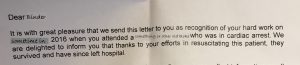
I opened my work tray the other day to find an envelope.  Inside was a letter.  A standard letter suggesting with all integrity that I (amongst others) had managed NOT to kill someone.

thank-you-300x65

Now, these letters don’t come often, but they do come.  In fact, I have a few now.  And I wager that anyone working in the job long enough will end up receiving at least one at some point.

I remember the job too . . . well, by process of elimination it’d be hard not to.  Of the five cardiac arrests I’ve done this year so far, only one of them wasn’t called on scene!

I would normally prefer to write about jobs that are either farcical in nature or tend to have some form of Frank Spencer-esque feeling about them.  So, it’s a bit weird (and rare) to write about something that . . . without trying to sound arrogant . . . went, um, so smooth.  Well, sort of.

Job simply came down as 70 year old male, unresponsive – red 2.  And, upon arrival I was presented with a venue that appeared perfect for the presentation of a cardiac arrest.  It was a large, empty, well lit room with a couple of chairs.  Near enough in the middle of the room lay my patient, on his back.  Quite possibly the best 360 degree access you could wish for.  Most people had left the room or were in the process of leaving and the only remaining folk were a couple of witnesses and friends of the patient.

As I was dumping my kit onto the floor I got the history . . .

“He said he felt a bit sick then just slumped to the floor”

Ah, short and sweet.  The way I like it!  Looking down at my patient I could see his fingers twitching and thought I could see some facial movement.  Therefore, thinking this was initially fake I leant down and went through the motions of DRABC.

D – Well, unless I’d missed a huge piano about to fall on my head or was about to be presented with an opening chest with teeth – like that scene in the film The Thing, where the chest opens and bites off the Dr’s hands when he performs CPR – I’m pretty sure I was free from danger.
R – I attempted the LAS’s preferred method of approach, calling out the patient’s name loudly and squeezing hard on the shoulder/neck region.  Nothing.  Oh, I thought, playing games are we?  I then flicked the eyelashes for a reaction.  Nothing.  Ah, I thought, that’s odd . . . in fact, is – is he breathing?
A – I quickly opened the patient’s airway for a quick check.  No resistance and clear.
B & C – Leaning down I watched his chest and instinctively went for both the patient’s carotid and radial pulses.  Nothing. Nothing and Nothing.

Well, what do you know.  I thought. You AREN’T faking it.

Continue reading

What It’s Like to be a Woman Working in Construction

While women represent nearly half of the labor force, they hold only 2.6 percent of construction jobs, according to the National Women’s Law Center (NWLC). The miniscule share of women in construction, a relatively highly paid industry, has barely budged in the past 35 years. There are more than 7,600,000 male construction workers in the U.S. but only about 206,000 women.

Here are some of those 206,00 women, telling their stories.

A Day in the Life of a Woman in Construction, written by Ana Taveras, a graduate of Nontraditional Employment for Women (NEW), which prepares, trains, and places women in careers in the skilled construction, utility, and maintenance trades.

Twenty Questions for Women in Construction was a series of blog posts about female construction workers in NYC which ran on Huffington Post in 2013.

California’s Division of Apprenticeship Standards (DAS) oversees an impressive building construction trades apprenticeship program. Here are the stories of apprentices Elena Talley and Frankie Roy.

5 Things I’ve Learned as a Female Working in Construction, posted by QueenAnneBoleynTudor at the online magazine Sunny Skyz.

I Was a Female Construction Worker For A Summer, And It Was The Best Job I’ve Ever Had, by Allie Ruhl at the online magazine Lala.

Patricia Valoy was not the typical worker when she began her apprenticeship at a construction site in college. As a woman of color, she is rare among construction workers: women make up just 2.6 percent of all employees in construction and extraction jobs, and about three-quarters of those women are white. So begins What It’s Like To Be One Of The Only Female Construction Workers In America in the online magazine Think Progress.

Into No Woman’s Land, War Stories of a Female Construction Worker is a book-length memoir by Amy R. Farrell about her life in heavy construction.